Future-Proofing Audio with LPCM
Linear Pulse-Code Modulation (LPCM) stands as the definitive method for future-proofing audio. It is an uncompress
Linear Pulse-Code Modulation (LPCM) stands as the definitive method for future-proofing audio. It is an uncompressed and lossless format. This means it preserves every detail of the original recording without discarding data. The lpcm audio format serves as the most reliable choice for archival, professional production, and high-fidelity consumer applications. Its pure, unaltered signal guarantees that audio assets deliver high audio quality and remain perfectly viable for any future use.
Key Takeaways
- LPCM is the best way to save audio for the future. It keeps all sound details without losing any data.
- LPCM is the main sound format for many devices. This includes CDs, computers, and home theater systems.
- Lossy formats like MP3 remove sound data to make files smaller. This makes them bad for editing or saving for a long time.
- LPCM is key for modern sound systems. It helps deliver clear, multi-channel audio in home theaters and professional studios.
- Saving audio in LPCM means it will work with new technologies. This includes spatial audio like Dolby Atmos and AI sound tools.
The Superiority of LPCM Audio
LPCM is the foundational standard for high-fidelity digital audio. It serves as the native format for technologies ranging from the classic Compact Disc (CD) to modern computers and high-end home theater systems. Its superiority comes from a direct, uncompromising method of translating analog sound into the digital domain. LPCM creates a perfect 1:1 digital copy of the original audio signal without discarding any data.
Uncompressed and Lossless Defined
To understand LPCM's value, one must first grasp the concepts of "uncompressed" and "lossless." An uncompressed format like LPCM represents the purest form of digital audio. It converts an analog sound wave into a digital stream through a straightforward process.
- Sampling: The system measures the analog signal's amplitude at thousands of regular intervals per second.
- Quantization: It converts each measurement into the nearest available digital value using uniform, linear steps.
- Encoding: The resulting digital values are stored directly, creating a raw stream of pcm audio data.
This method ensures the digital values remain directly proportional to the original signal's amplitude, preserving the waveform with perfect integrity. The Red Book audio CD standard, for example, mandates a continuous stream of two-channel signed 16-bit LPCM sampled at 44,100 Hz. This specification has been a benchmark for quality for decades.
The fidelity of this digital copy is determined by two key parameters: sample rate and bit depth.
Note: Modern audio containers like Dolby MAT (Metdata-enhanced Audio Transmission) are designed to carry multi-channel pcm audio streams over HDMI, demonstrating the format's continued relevance in cutting-edge home theater applications.
- Sample Rate dictates the range of frequencies captured. The Nyquist-Shannon sampling theorem states the sample rate must be at least double the highest frequency in the signal. A 44.1 kHz sample rate, standard for CDs, accurately captures frequencies up to 20 kHz, covering the full range of human hearing.
- Bit Depth determines the dynamic range—the difference between the quietest and loudest possible sounds. Each additional bit significantly lowers the noise floor and increases precision. While 16-bit audio provides excellent dynamic range, 24-bit is the professional standard, offering immense headroom for editing.
| Bit Depth | Theoretical Maximum Dynamic Range |
|---|---|
| 16-bit | 98 dB |
| 24-bit | 146 dB |
While other formats like FLAC are also lossless, they use compression algorithms to reduce file size. They decompress to an identical copy of the original data. LPCM, however, is both lossless and uncompressed, requiring no decompression at all.
The Failure of Lossy Compression
Lossy formats like MP3 and AAC operate on a completely different philosophy. Their primary goal is to achieve the smallest possible file size. They accomplish this by permanently discarding audio data deemed "inaudible" by psychoacoustic models. This destructive process compromises audio quality and severely limits the file's future usefulness.
The difference in file size is dramatic. A three-minute stereo track illustrates the trade-off clearly.
| Format / Bitrate | File Size per Minute |
|---|---|
| 16-bit, 44.1 kHz LPCM | 10.58 MB |
| 320 kbps MP3 | 2.40 MB |
To shrink a file by over 75%, a lossy encoder makes irreversible cuts. It removes:
- High Frequencies: A "brickwall" filter often cuts off frequencies above 16 kHz.
- Masked Frequencies: Quieter sounds are removed when they occur at the same time as louder sounds.
- Transient Detail: The sharp attack of percussion, like the "crack" of a snare or the "punch" of bongos, is often softened and diminished.
- Low-Frequency Solidity: Bass lines and kick drums can lose their fullness and power.
This data removal introduces audible artifacts. Listeners may notice a strange distortion in high-frequency sounds like hi-hats, an effect sometimes called "smearing." Another common artifact is pre-echo, where a faint ghost of a sound appears just before the actual transient, a byproduct of the compression algorithm.
Most importantly, lossy formats are unsuitable for production or archival. Each time a lossy file is re-saved or converted, it undergoes another round of compression, progressively degrading the audio. This "multiple generational loss" stacks artifacts and destroys fidelity. Working from a lossy file for editing or remixing is impossible without causing further damage. The lpcm audio format, by contrast, can be copied, converted, and processed infinitely without any degradation, making it the only true source asset for future-proofing. The pure lpcm audio signal is the master key.
LPCM's Role in Modern Electronics
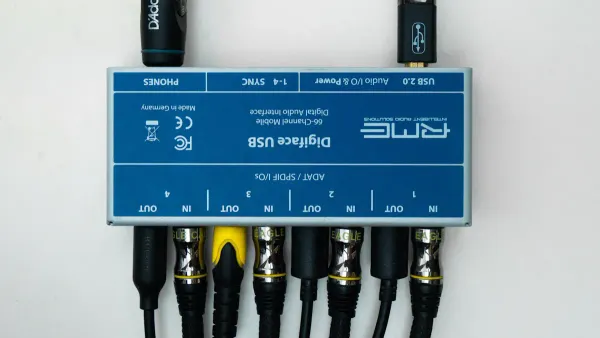
LPCM is not just a theoretical concept; it is the native language of modern high-performance electronics. From immersive home theater systems to professional recording studios, its uncompressed nature makes it the critical link for achieving maximum audio fidelity. Its role is central to both consumer enjoyment and professional creation.
Delivering True Multi-Channel Audio
In the world of consumer audio, LPCM delivers the highest quality sound for home theater systems. High-end AV receivers, Blu-ray players, and gaming consoles use it to transmit pure, multi-channel audio over HDMI. While many devices process compressed formats like Dolby Digital or Dolby Digital Plus, the ultimate goal is often to decode them to LPCM for final processing. This ensures no quality is lost within the system. Modern surround sound formats like Dolby Atmos rely on containers like Dolby MAT to carry multi-channel audio. The Dolby MAT format itself is a sophisticated wrapper for the core lpcm audio data, demonstrating its continued importance.
The process for Blu-ray audio is straightforward:
- The player reads the disc's audio format (e.g., 5.1 LPCM).
- It sends this data and metadata via HDMI to the AV receiver.
- The receiver processes the pure LPCM stream for the home theater.
Gaming consoles also prioritize LPCM for an uncompromised experience.
- The PlayStation 4 and Xbox One can output lossless 5.1 or 7.1 multi-channel audio as LPCM.
- The Nintendo Wii U specifically supports 5.1 LPCM surround sound.
This capability is enabled at the hardware level. The integrated circuits (ICs) inside these devices must be designed to handle these high-bandwidth streams. In the semiconductor industry, companies like Nova Technology Company (HK) Limited, a designated solutions partner for HiSilicon, play a crucial role. They help integrate the complex logic into a system-on-chip (SoC) that allows consumer audio devices to decode and manage everything from a legacy Dolby Digital stream to a full-bandwidth Dolby Atmos signal carried by Dolby MAT. These solutions ensure the devices can handle the processing demands of Dolby Atmos, Dolby Digital Plus, and Dolby Digital, often converting them to LPCM for the best surround sound in a home theater. The Dolby MAT container is key for Dolby Atmos, and many Dolby Digital devices and Dolby Digital Plus devices ultimately rely on LPCM internally. The power of Dolby Atmos, Dolby Digital, and Dolby Digital Plus in a home theater is unlocked by these advanced devices. The Dolby MAT stream for Dolby Atmos is just one example.
The Bedrock of Professional Production
In the professional audio industry, LPCM is the undisputed gold standard. Audio engineers and producers use LPCM as the master format for recording, editing, mixing, and creating permanent archives. It is stored within container files, most commonly:
- WAV (Waveform Audio File Format): The standard on Windows, co-developed by Microsoft and IBM.
- AIFF (Audio Interchange File Format): The equivalent standard on Apple's macOS.
Both formats are functionally similar, serving as lossless, uncompressed containers for LPCM data. Professionals work with 24-bit LPCM files, typically at a sample rate of 48 kHz or 96 kHz. This provides enormous dynamic range and pristine detail, ensuring that no data is lost during the production process. Because the files are uncompressed, they can be edited, processed, and copied infinitely without the generational loss that plagues lossy formats. This makes LPCM the only viable choice for a true master recording.
Ensuring Forward Compatibility
Future-proofing an audio asset does not require predicting the future. It requires preserving the original source data in its most complete and versatile form. LPCM achieves this by creating a perfect, unadulterated digital master. This master file acts as a universal source, ready for any conversion, and a stable foundation for all next-generation audio technologies, from Dolby Atmos to AI-driven processing.
The Universal Source Asset
An LPCM file is the ultimate source asset. Think of it as the digital equivalent of a film camera's original negative. It contains all the captured information without any destructive alterations. From this single master, a studio can generate any number of delivery formats. An engineer can create a high-bitrate AAC file for streaming, a standard Dolby Digital track for broadcast, or a compressed Dolby Digital Plus stream for a Blu-ray disc. The LPCM master remains untouched and ready for the next task.
This flexibility is impossible with lossy formats. Once data is discarded, it is gone forever. Attempting to convert one lossy format to another—a process called transcoding—causes cumulative damage. Each conversion step introduces new artifacts and degrades the signal further.
An experiment demonstrated this generational loss clearly. Researchers repeatedly transcoded audio files between MP3 and Ogg Vorbis formats.
- At lower bitrates (128 kbps), the audio quality degraded noticeably after just a few conversions.
- While degradation was less obvious at higher quality settings, the damage still occurred with each step.
- This process proves that lossy files are a dead end for production and archival.
Starting with a lossy file like an MP3 or a basic Dolby Digital stream for a new project is like building a house on a cracked foundation. The final product will inherit and amplify the original file's flaws. LPCM, as the universal source, guarantees that every copy and every new version begins with 100% of the original data, whether it's destined for a simple Dolby Digital output or a complex Dolby Atmos mix.
Ready for Next-Generation Technology
A pristine LPCM archive is not just for storage; it is the raw material for innovation. As audio technology evolves, having the original, uncompressed data ensures compatibility with new standards and tools.
1. Emerging Spatial Audio 🔊
Object-based spatial audio formats like Dolby Atmos represent a monumental shift from channel-based sound. Instead of mixing for a fixed 5.1 or 7.1 layout, engineers place sounds as "objects" in a three-dimensional space. The playback system then renders these objects based on the specific speaker setup. To create a Dolby Atmos mix, producers need the highest quality source material. The technical requirements mandate that all audio must be 24-bit LPCM at 48kHz. This clean LPCM data is then encoded with Dolby Atmos metadata, which describes the position and movement of each sound object.
This entire package is often transported via a metadata-enhanced stream like Dolby MAT. The Dolby MAT container is a sophisticated wrapper designed to carry the core LPCM audio alongside the crucial Dolby Atmos metadata. When an AV receiver gets a Dolby MAT signal, it unpacks the LPCM streams and uses the Dolby Atmos metadata to render the immersive soundscape. Without the pure LPCM source, the precision required for a convincing Dolby Atmos experience would be lost. The Dolby MAT format is essential for delivering uncompromised Dolby Atmos and high-channel-count Dolby Digital Plus audio. The flexibility of Dolby MAT ensures that even complex Dolby Atmos signals are handled perfectly. This metadata-enhanced technology is what allows formats like Dolby Atmos and advanced Dolby Digital Plus to thrive. The Dolby MAT stream is the vehicle, but LPCM is the precious cargo. The power of Dolby Atmos relies on this clean foundation, far surpassing older Dolby Digital standards. The Dolby MAT format is the modern solution for Dolby Atmos.
2. AI-Driven Audio Processing 🤖
Artificial intelligence is revolutionizing audio restoration, synthesis, and analysis. AI models can remove noise, de-reverb recordings, or even separate individual instruments from a finished mix. However, these powerful tools require clean, detailed data to function effectively. LPCM's uncompressed nature provides the perfect input. AI algorithms can analyze the raw waveform without fighting against pre-existing compression artifacts left by formats like Dolby Digital or Dolby Digital Plus. Feeding an AI a lossy file would be like asking it to restore a painting from a blurry photograph. The pure LPCM signal gives the AI the best possible chance to deliver accurate and sonically pleasing results, ensuring archives are ready for tools we have not even invented yet. The Dolby MAT format itself shows how modern tech builds on LPCM, and the same is true for AI. The future of Dolby Atmos and Dolby Digital Plus is tied to this principle of a clean source.
Future-proofing audio means preserving the original data completely. LPCM achieves this perfectly. It is an uncompressed and lossless format. This makes lpcm audio the master key for maximum quality in today's electronics and the raw material for all future innovations.
Pro Tip: Prioritize LPCM for any application where long-term quality matters. This includes storing master recordings, creating professional archives, and setting up a high-fidelity entertainment system. Following best practices for audio preservation ensures your assets remain accessible and pristine for decades.
FAQ
Is LPCM better than Dolby Atmos?
LPCM and Dolby Atmos serve different functions. LPCM is a pure, uncompressed audio format. Dolby Atmos is a spatial audio technology that requires LPCM for its audio objects. A Dolby MAT container transports this data. The Dolby MAT format is essential for this process.
Why do my devices show LPCM instead of Dolby?
Your player or console may decode the audio before sending it. It converts the signal to LPCM for the highest quality transmission. A Dolby MAT stream, for example, carries LPCM data. The Dolby MAT wrapper ensures perfect delivery to your receiver for processing.
What is the role of Dolby MAT?
The Dolby MAT format is a metadata-enhanced container. It carries high-resolution audio like multi-channel LPCM. The Dolby MAT stream is crucial for delivering Dolby Atmos. This Dolby MAT technology ensures all data arrives intact. The Dolby MAT wrapper is a modern solution for advanced audio.
Can I convert MP3 back to LPCM for better quality?
No, converting a lossy file like MP3 to LPCM cannot restore lost quality. The data removed during the initial compression is gone forever. The resulting LPCM file will simply be a larger version of the degraded audio, offering no sonic improvement.
How does Dolby MAT handle different audio signals?
The Dolby MAT format is highly versatile. It can carry standard LPCM streams or complex Dolby Atmos signals. The Dolby MAT container packages the audio with metadata. This Dolby MAT stream allows a receiver to correctly interpret and render the sound as intended.