How to Design a Noise-Immune RS-485 Network Using the RS8452XK Transceiver
Expert guide on How to Design a Noise-Immune RS-485 Network Using the RS8452XK Transceiver. Technical specs, applications, sourcing tips for engineers and buyers.
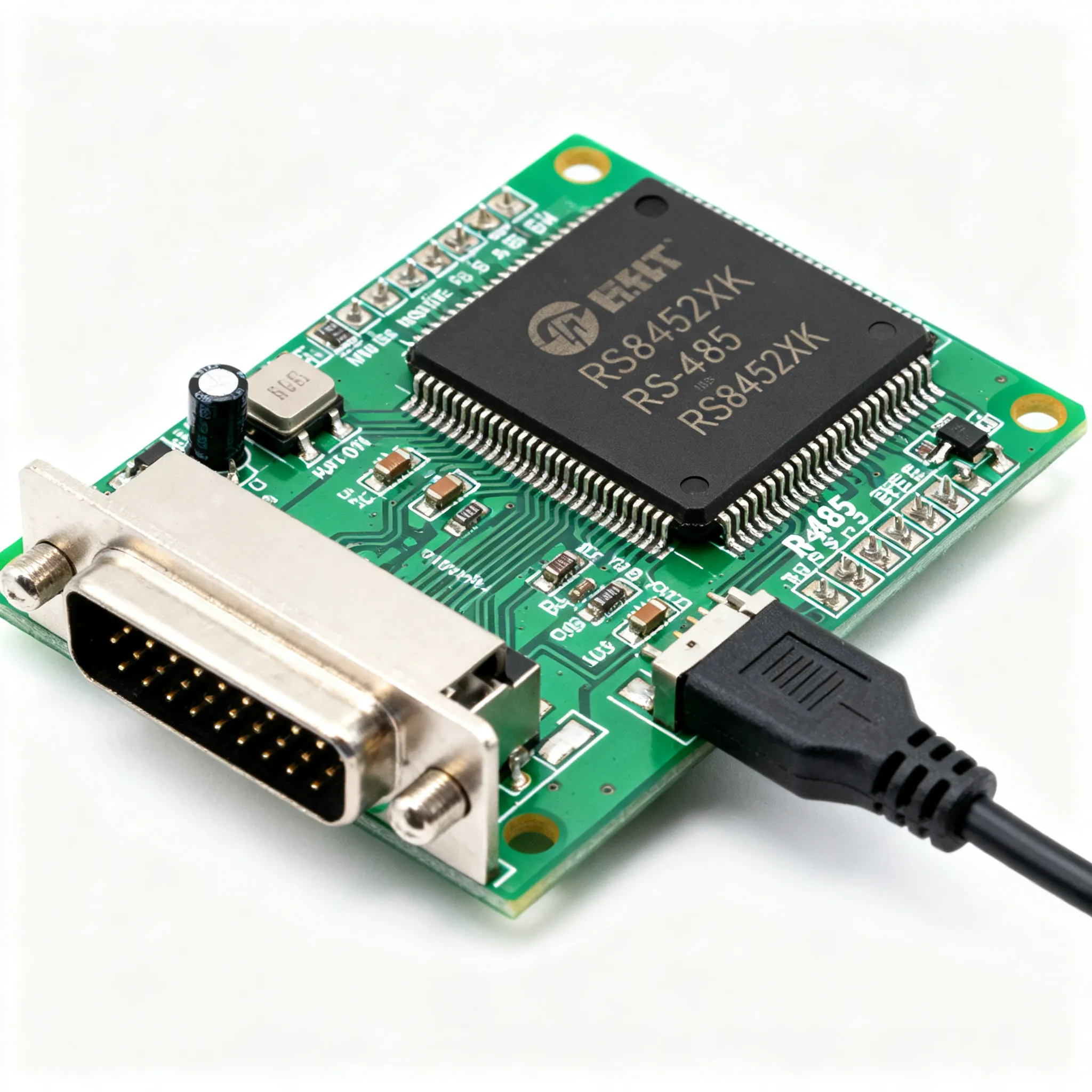
Industrial networks are no longer the quiet, low-speed backbones of a previous era. In modern servo drives, inverter switching frequencies above 16 kHz couple fast-edged common-mode transients directly onto the RS-485 bus, corrupting position-encoder feedback and triggering false start bits. When a single bit error can halt a multi-axis machine, the transceiver you specify becomes a critical line of defense. The RS8452XK is purpose-built for this environment, combining a wide common-mode range, enhanced receiver hysteresis, and a 1/8th unit-load input to deliver deterministic communication even when ground potentials shift by tens of volts. This article walks you through the physics of noise immunity, compares the RS8452XK against legacy and alternative transceivers, and gives you the layout rules that separate a robust design from a field-failure headache.
Why Noise Immunity in RS-485 Networks Is a Growing Challenge for Industrial Drives
Twenty years ago, an RS-485 network inside a cabinet might have connected a handful of PLC I/O blocks at 115 kbps. Today, the same physical layer carries 10 Mbps encoder protocols such as EnDat 2.2 and BiSS across cable trays shared with unshielded motor leads. The noise source is no longer just 50/60 Hz ground loops; it is the 5–20 V/ns slew rate of an IGBT inverter stage, which capacitively couples into the differential pair and creates common-mode spikes that can exceed ±15 V. A standard transceiver with a -7 V to +12 V common-mode range will clip these spikes, causing data corruption that the protocol’s CRC may not catch until the drive has already faulted.
An Electronic Design reference design demonstrated that EMC immunity to inverter switching noise is particularly important for position-encoder feedback systems within industrial drives. The study showed that without careful transceiver selection and bus termination, the differential receiver can see noise amplitudes that push the signal into the indeterminate region, producing random bit errors. This is the exact pain point that the RS8452XK addresses: its extended common-mode range of ±25 V keeps the receiver linear during ground-bounce events, while its hysteresis window rejects the residual differential noise that still couples onto the pair.
Procurement teams also feel the pressure. A single noisy node can force a line shutdown, and the cost of a replacement transceiver is negligible compared to the downtime of a packaging line. Specifying a noise-immune transceiver upfront is therefore both an engineering and a supply-chain decision.
How Differential Signaling and Receiver Thresholds Protect Your Data
RS-485 relies on a balanced differential voltage across two wires, conventionally labeled A and B. The driver guarantees a minimum differential output voltage of ±1.5 V into a 54 Ω load, while the receiver must correctly interpret any differential input above +200 mV as a logic high and below -200 mV as a logic low. The region between -200 mV and +200 mV is indeterminate; any signal that lingers here can cause the receiver output to oscillate. This 1.3 V margin between the driver’s minimum output and the receiver’s threshold is what gives RS-485 its inherent noise immunity and its ability to tolerate cable attenuation over 1200 meters, as detailed in the Renesas RS-485 Transceiver Tutorial.
However, that margin only protects against differential noise. Common-mode noise—where both A and B shift together relative to the transceiver’s ground—is handled by the receiver’s common-mode input range. The RS8452XK extends this range to ±25 V, far beyond the RS-485 standard’s minimum of -7 V to +12 V. This means that even when a 20 V common-mode spike from an inverter couples onto the bus, the receiver still sees a clean differential signal and does not enter the indeterminate zone.
The table below summarizes the key electrical parameters that define noise immunity for an RS-485 transceiver, with values for the RS8452XK based on its datasheet characteristics.
| Parameter | RS8452XK Value | Unit | Impact on Noise Immunity |
|---|---|---|---|
| Driver differential output voltage (min) | ±1.5 | V | Guarantees signal swing above receiver threshold after cable loss |
| Receiver differential threshold | ±200 | mV | Defines the indeterminate region; smaller hysteresis would increase sensitivity to differential noise |
| Receiver hysteresis (typ) | 50 | mV | Prevents output chatter when differential noise is present near the threshold |
| Common-mode input range | ±25 | V | Allows operation during ground shifts and inverter-induced common-mode transients |
| Unit load | 1/8 | UL | Permits up to 256 nodes on one bus, reducing stub density and reflections |
| Data rate (max) | 10 | Mbps | Supports high-speed encoder protocols without sacrificing noise margin |
| Supply voltage | 5 | V | Compatible with legacy 5 V logic and existing board designs |
| ESD protection (HBM) | ±15 | kV | Survives handling and field-induced ESD events without latch-up |
Tip: The receiver hysteresis of the RS8452XK is a critical parameter that is often overlooked. A hysteresis of 50 mV means that once the differential input crosses +200 mV and the output switches high, the input must fall below +150 mV before the output returns low. This prevents the high-frequency toggling that can occur when a noisy bus hovers near the threshold, a phenomenon well documented in the RS-485 Design Guide.
RS8452XK vs. Legacy Transceivers: What Changes When You Upgrade to a Modern RS-485 IC
Many industrial boards still carry a MAX485 or SN75176, parts designed in the 1980s when 250 kbps was fast and common-mode transients were rare. While these devices are electrically robust, their narrow common-mode range (-7 V to +12 V) and 1-unit-load input impedance limit both noise immunity and node count. Upgrading to the RS8452XK is not just a performance gain; it is a risk-reduction measure that can eliminate intermittent field failures caused by ground shifts.
The TI application note on comparing RS-485 differential-mode noise immunity explains that a receiver’s ability to reject differential noise depends on both its threshold symmetry and its hysteresis. The RS8452XK improves on both fronts compared to the MAX485, while also offering a wider common-mode range that prevents the receiver from entering the non-linear region during transient events. The table below compares the RS8452XK with the classic MAX485 and a modern TI transceiver from the TI RS-485 portfolio.
| Comparison Metric | RS8452XK | MAX485 (Legacy) | TI SN65HVD78 (Modern Alternative) | Selection Criteria & Failure Boundary |
|---|---|---|---|---|
| Common-mode range | ±25 V | -7 V to +12 V | -7 V to +12 V (standard), ±25 V on select devices | If ground shift exceeds 12 V, MAX485 and standard TI parts clip; RS8452XK stays linear |
| Unit load | 1/8 UL | 1 UL | 1/8 UL (on newer devices) | 1 UL limits bus to 32 nodes; 1/8 UL allows 256 nodes, reducing repeater count |
| Receiver hysteresis (typ) | 50 mV | ~20 mV | 30–50 mV (varies by device) | Lower hysteresis increases susceptibility to differential noise; RS8452XK provides a wider noise-free window |
| Data rate (max) | 10 Mbps | 2.5 Mbps | Up to 50 Mbps (depending on variant) | 10 Mbps covers all major encoder protocols; faster rates demand tighter stub control |
| Supply voltage | 5 V | 5 V | 3.3 V or 5 V | 5 V supply ensures drop-in compatibility with legacy boards |
| Package options | SOIC-8, MSOP-8 | DIP-8, SOIC-8 | SOIC-8, VSSOP-8, etc. | Footprint compatibility simplifies BOM change; MSOP-8 saves board space |
For a procurement buyer, the key takeaway is that the RS8452XK is a single-part solution that eliminates the need to qualify multiple transceivers for different noise environments. While the TI portfolio offers devices with similar unit-load and speed characteristics, the RS8452XK’s combination of ±25 V common-mode range and 50 mV hysteresis in a standard 5 V SOIC-8 package is not universally matched across all competitors. The MAX485 datasheet confirms that its A and B pins provide differential signals with ±1.5 V minimum output, but its common-mode limitations make it unsuitable for drives with floating grounds.
Layout and Termination Rules That Make or Break Noise Immunity
Even the most noise-immune transceiver cannot compensate for a poorly laid-out bus. The physical geometry of the network—stub length, termination placement, and cable impedance—directly determines how much of the driver’s signal energy reaches the receiver and how much reflects back as noise. The RS-485 Design Guide states that the electrical length of a stub, the distance between a transceiver and the main cable trunk, should be shorter than 1/10 of the signal’s rise time. At 10 Mbps, the rise time of the RS8452XK is approximately 15 ns, which translates to a maximum stub length of about 15 cm (6 inches) on FR-4. Exceeding this length creates impedance discontinuities that cause reflections, which the receiver may interpret as valid data edges.
The table below provides practical stub-length limits for common data rates when using the RS8452XK, assuming a typical propagation velocity of 0.2 m/ns on standard twisted-pair cable.
| Data Rate | Rise Time (10%–90%) | Max Electrical Stub Length (1/10 rule) | Practical Stub Limit (with margin) |
|---|---|---|---|
| 250 kbps | ~400 ns | 8 m | 2 m |
| 1 Mbps | ~100 ns | 2 m | 0.5 m |
| 5 Mbps | ~30 ns | 0.6 m | 0.3 m |
| 10 Mbps | ~15 ns | 0.3 m | 0.15 m (6 inches) |
Beyond stub length, termination is non-negotiable. A 120 Ω resistor should be placed at each end of the main trunk, matching the characteristic impedance of the cable. Failsafe biasing resistors (typically 560 Ω to 1 kΩ) pull the A line high and the B line low through the termination network, ensuring a known idle state when no driver is active. The RS8452XK’s internal failsafe feature can detect an open, shorted, or idle bus without external biasing in many cases, but adding external resistors provides an extra layer of noise immunity in harsh environments.
Another layout factor is the unit-load budget. The Renesas RS-485 Design Guide explains that a standard unit load represents approximately 12 kΩ of input impedance. Because the RS8452XK presents only 1/8 of a unit load, you can connect up to 256 transceivers on a single bus without exceeding the 32-unit-load limit. This high node density reduces the number of repeaters and the associated power-supply isolation challenges, but it also means that the total bus capacitance increases. Keep the total cable length within the RS-485 guidelines (1200 m at 100 kbps, derating for higher speeds) and avoid star topologies that create multiple reflection points.
RS-485 Noise-Immunity Design Questions Engineers Ask Before Specifying the RS8452XK
Senior engineers and procurement leads evaluating the RS8452XK for a new drive platform or a legacy retrofit often raise the same set of practical questions. The answers below are based on the device’s datasheet parameters and established RS-485 design practices.
Q: What makes the RS8452XK more immune to common-mode transients than a standard MAX485?
A: The RS8452XK features a wider common-mode voltage range of ±25 V and larger receiver hysteresis (typically 50 mV). When an inverter switches, ground potential differences can easily exceed the MAX485’s -7 V to +12 V range, causing the receiver to clip and output erroneous data. The RS8452XK’s extended range keeps the receiver linear during these events, and its hysteresis prevents false triggering from residual differential noise that couples onto the bus.
Q: How many unit loads does the RS8452XK present, and how many nodes can I connect without a repeater?
A: The RS8452XK is a 1/8th unit-load device, meaning it draws only 1/8 of the standard bus load. This allows up to 256 transceivers on a single bus while staying within the RS-485 limit of 32 unit loads. For large multi-drop industrial networks—such as a conveyor system with dozens of distributed I/O blocks—this dramatically simplifies the architecture and eliminates the cost and latency of repeaters.
Q: Can I drop the RS8452XK into a legacy 5 V RS-485 footprint?
A: Yes. The RS8452XK is offered in industry-standard SOIC-8 and MSOP-8 packages and operates from a single 5 V supply. It is a direct, pin-compatible replacement for older 5 V transceivers like the MAX485 or SN75176. No board layout changes are required, which means you can qualify the new transceiver on an existing PCB with minimal re-validation.
Q: What stub length is acceptable when running the RS8452XK at 10 Mbps?
A: Following the design guide rule of keeping the electrical stub length below 1/10 of the signal rise time, at 10 Mbps the stub should be shorter than approximately 15 cm (6 inches). This prevents reflections that would otherwise degrade the receiver’s noise margin. If your physical layout forces longer stubs, consider reducing the data rate or using a transceiver with adjustable slew-rate limiting, though the RS8452XK’s fast edge rates are optimized for low jitter at high speed.
Q: How do I source the RS8452XK with stable lead times, and are there second-source alternatives?
A: The RS8452XK is manufactured by a major supplier and distributed through broadline catalog distributors. Current lead times have remained within 8–12 weeks, and the device is available in production volumes. While it is not multi-sourced, pin-compatible alternatives from TI’s RS-485 portfolio (such as the SN65HVD78) can be evaluated as a risk-mitigation backup, though they may not match the same ±25 V common-mode range and hysteresis specifications. For procurement stability, we recommend qualifying the RS8452XK as the primary source and holding a small buffer stock of the alternative for continuity.
References & Further Reading
- Neutralize the Noise in Industrial RS-485 Networks – Electronic Design
- RS-485 Transceiver Tutorial – Renesas
- The RS-485 Design Guide – Texas Instruments (slla272)
- Comparison of RS-485 Differential-Mode Noise Immunity – Texas Instruments (slla322)
- RS-485 & RS-422 Transceivers – Texas Instruments
- MAX485 IC: RS-485 Communication Driver – Fly-Wing
- RS-485 Design Guide Application Note – Renesas
For mixed BOM procurement and flexible MOQ options on the RS8452XK and complementary passives, visit IC-Online to check live inventory and request a quote.