IGBT vs MOSFET Evaluating Efficiency and Reliability
IGBT vs MOSFET: Compare efficiency, reliability, and best use in consumer and industrial electronics to choose the right power device for your needs.
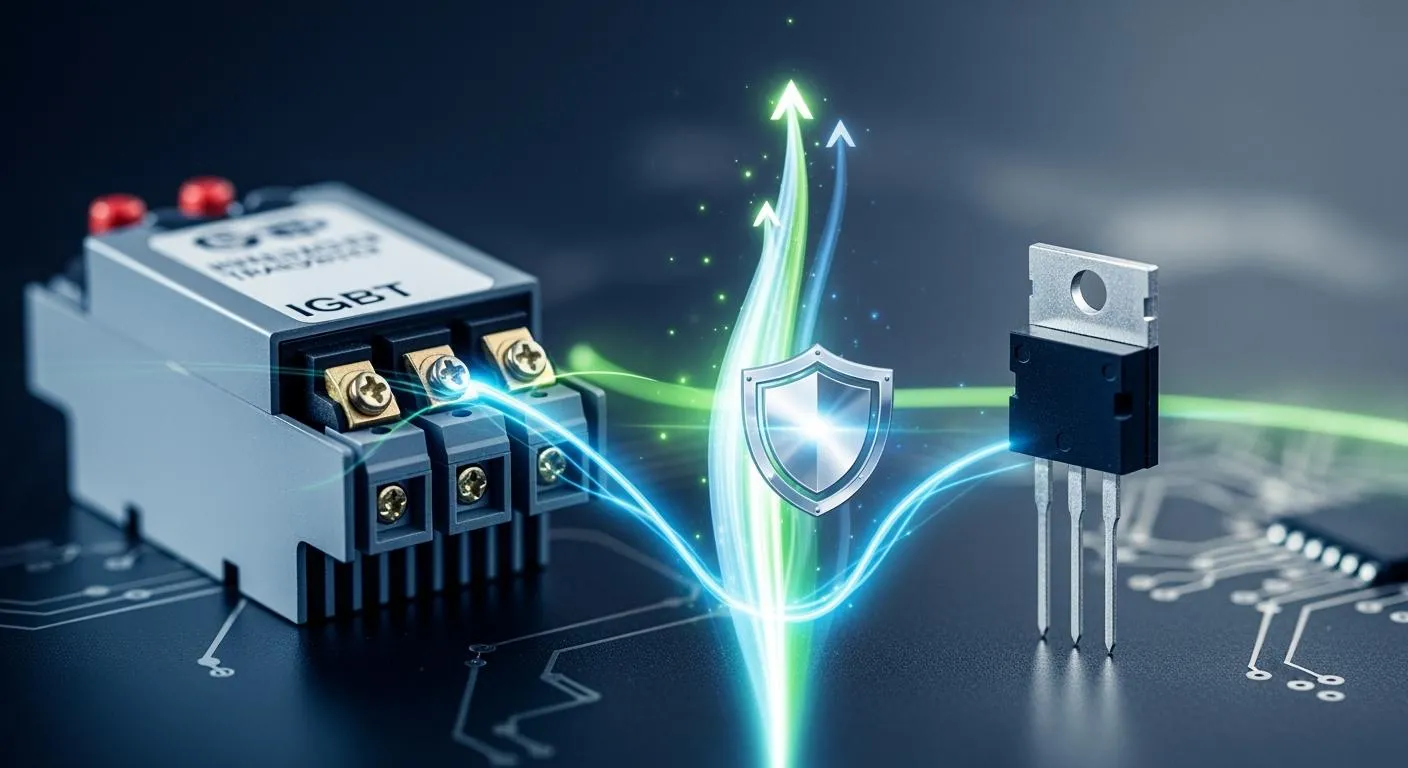
When you compare igbt vs mosfet for efficiency and reliability, you find that MOSFETs usually perform better in low-voltage, high-speed switching systems, while IGBTs handle higher voltages and currents more effectively. Choosing the right one can boost your system’s performance and lower costs. Here is a quick look at their key differences:
| Feature | IGBT | MOSFET |
|---|---|---|
| Voltage | High voltage | Low voltage |
| Current | Higher current handling | Lower current handling |
| Switching Speed | Slower | Faster, ideal for high-frequency |
| Integration | Less compact | Compact, high-density circuits |
Key Takeaways
- Choose IGBT for high-voltage and high-current applications like industrial motor drives and solar inverters.
- Select MOSFET for low-voltage, high-speed switching tasks such as battery management systems and LED drivers.
- Understand that IGBTs handle higher power but switch slower, while MOSFETs excel in fast switching with lower power.
- Implement effective thermal management strategies to enhance reliability and prevent overheating in both IGBT and MOSFET devices.
- Always match your device choice to the specific voltage, current, and switching speed requirements of your application.
IGBT vs MOSFET: Key Differences
When you compare power transistors, you need to understand how igbt vs mosfet devices differ in structure and operation. These differences shape their performance in various systems and applications.
| Feature | MOSFET | IGBT |
|---|---|---|
| Type | Unipolar device | Bipolar device |
| Conduction | Majority carriers only | Both majority and minority carriers |
| Switching Speed | Fast | Slower than MOSFET |
| Saturation Voltage Drop | Higher losses at high currents | Low saturation voltage drop |
| Application Suitability | Low to medium power applications | High power applications |
Voltage and Current Capabilities
You will see that voltage and current ratings play a big role in choosing between igbt and mosfet devices. In industrial applications, you often need to handle high voltages and large currents. Here is a comparison of typical ratings:
| Device Type | Voltage Rating | Current Rating |
|---|---|---|
| Power BJT | High <1 kV | High <500 A |
| Power MOSFET | High <1 kV | Low <200 A |
| IGBT | Very high >1 kV | High >500 A |
IGBTs can manage very high voltages (over 1 kV) and high currents (over 500 A). This makes them ideal for heavy-duty power electronics, such as industrial motor drives, solar inverters, and welding machines. You can use igbt devices in systems where you need to control large amounts of power with minimal losses.
MOSFETs, on the other hand, work best at lower voltages (below 1 kV) and lower currents (below 200 A). You will find mosfet devices in applications that require fast switching and high efficiency at lower power levels. These include battery management systems, LED drivers, and ultrasonic inverters.
Tip:
Choose igbt for high-voltage, high-current tasks. Use mosfet for low-voltage, high-speed switching.
Here are some common applications for each device:
- IGBTs:
- Industrial motor drives (handle 600V-1200V and large currents)
- Solar inverters (convert high DC voltage, operate at 20kHz)
- DIY welding machines (manage 50-100A at 300VDC)
- MOSFETs:
- Ultrasonic inverters (operate at 100kHz with low losses)
- Motor controllers (high switching speed, low voltage)
- LED drivers (dim high-power LEDs at >100kHz)
- Battery management systems (charge/discharge at 4V-60V)
Switching Speed and Integration
Speed is a key factor in many modern systems. MOSFETs switch much faster than IGBTs. You can use mosfet devices in circuits that need to operate at frequencies above 100 kHz. This high speed comes from their unipolar structure, which means they do not store minority carriers. As a result, you get quick response and efficient operation in high-frequency applications.
| Device | Characteristics | Practical Impact |
|---|---|---|
| MOSFET | Voltage-controlled, no minority carrier storage, very fast switching capability | Low Qg → high-frequency capability (100 kHz+) |
| IGBT | MOS gate with bipolar conduction, minority carrier device, lower conduction loss at high voltage | Well suited for low–to–medium switching frequencies |
IGBTs switch slower because they use both majority and minority carriers. This limits their speed, so you will see them used in applications with lower switching frequencies. However, they offer lower conduction losses at high voltages, which is important for large-scale power control.
Integration also matters in circuit design. MOSFETs require a gate voltage of 10-15V and have simpler drive requirements. You can easily integrate them into compact, high-density circuits. IGBTs need a higher gate voltage (15-20V) and more complex drive circuits. This makes them less compact and a bit harder to integrate, especially in space-limited designs.
| Component | Gate Voltage | Drive Complexity | Switching Speed |
|---|---|---|---|
| MOSFET | 10-15V | Simpler | Faster |
| IGBT | 15-20V | More Complex | Slower |
Note:
If your design needs high speed and easy integration, choose mosfet. For high power and voltage, igbt is the better option.
By understanding these differences, you can select the right device for your power electronics project. Each device has strengths that fit specific applications, so match the device to your system’s needs for the best results.
How IGBT Works
Operating Principle
You can understand the igbt by looking at how it combines features from two types of transistors. The igbt uses a small voltage at its insulated gate to control a large current between its collector and emitter. This voltage-controlled behavior makes it easy for you to manage power in your circuit. The internal structure blends a MOSFET for voltage control and a bipolar junction transistor (BJT) for high current conduction. When you apply a positive voltage to the gate, an electric field forms and triggers current flow between the collector and emitter. This setup allows you to modulate current precisely and create accurate output waveforms. The igbt is essential in systems where you need to control large currents with minimal input power.
- The gate voltage directly influences the current between collector and emitter.
- The igbt mimics MOSFET behavior but delivers strong output currents like a BJT.
- You use a small gate voltage to control a large current flow.
- The hybrid structure results in efficient, high-power switching.
- Applying a positive gate voltage triggers current flow.
- You can modulate current precisely for accurate waveforms.
- The igbt is crucial for applications needing control over large currents with minimal input power.
Strengths and Drawbacks
You should weigh the strengths and drawbacks before choosing an igbt for your project. The device offers high power capability and low conduction losses, making it ideal for demanding applications. You can drive the gate easily, and it provides good switching speed in the range of 1–20 kHz. However, you may face higher switching losses compared to MOSFETs. The igbt switches slower and can be at risk of thermal runaway if not managed properly.
| Strengths | Drawbacks |
|---|---|
| High Power Capability | Higher Switching Losses than MOSFETs |
| Low Conduction Losses | Slower Switching Speed |
| Simple Gate Drive | Risk of Thermal Runaway |
| Good Switching Speed (1-20 kHz) |
Tip:
You should use igbt devices when you need to handle high voltages and currents, but always monitor thermal conditions to avoid reliability issues.
How MOSFET Works
Operating Principle
You can control a mosfet by applying voltage to its gate terminal. This voltage creates an electric field between the gate and source. When the gate-source voltage (VGS) stays below a certain threshold, the mosfet remains off and blocks current. If you increase VGS above the threshold, a conductive channel forms between the drain and source. This channel lets current flow through the device.
- The gate voltage forms an electric field that controls the flow of charge carriers.
- When VGS is less than the threshold voltage, the mosfet stays in the cutoff region and only a tiny leakage current passes.
- If VGS rises above the threshold, an inversion layer appears, and the device turns on.
- The mosfet can operate in three regions: cutoff (off), linear (acts like a resistor), and saturation (acts like a current source).
You can adjust the current by changing the gate voltage. In the saturation region, the drain current depends mostly on VGS. In the linear region, the current increases with the voltage between drain and source. This flexibility makes the mosfet a popular choice for switching and amplification in many electronic circuits.
Tip:
You can use mosfet devices for both switching and analog signal control because of their precise gate voltage operation.
Strengths and Drawbacks
You should know the main strengths and drawbacks before choosing a mosfet for your design. The table below gives a clear comparison:
| Strengths | Drawbacks |
|---|---|
| High Efficiency | Limitations in high-voltage cases |
| Scalability | |
| Reliability |
You get high efficiency when you use mosfet devices in low- and medium-voltage applications. These devices scale well for integration into compact circuits. You can also rely on their stable performance in many consumer and industrial systems. However, mosfet devices may not perform as well in high-voltage scenarios. You should consider this if your application requires handling very large voltages.
Note:
Choose mosfet devices for fast switching, high efficiency, and reliable operation in low- to medium-voltage systems.
Energy Efficiency Comparison
On-Resistance and Power Loss
You need to understand how on-resistance and power loss affect the energy efficiency of igbt vs mosfet devices. These two factors play a big role in the performance of power electronics, especially in high-voltage circuits and high-frequency switching systems.
On-resistance is the resistance that current faces when it flows through a device in the "on" state. Lower on-resistance means less power wasted as heat. In mosfet devices, on-resistance is a key factor. It causes conduction losses that increase with the square of the current. This means that as current rises, mosfet devices lose more power. For example, if you double the current, the power loss becomes four times greater.
IGBT devices work differently. They have a fixed voltage drop, called the saturation voltage, when they conduct. The conduction loss in an igbt increases linearly with current. For instance, if the saturation voltage is 1.9V and the current is 40A, the conduction loss is 76W. This linear relationship makes igbt devices more efficient in high-current, high-voltage circuits.
Here is a table that compares the main power loss factors for both devices:
| Parameter | IGBT | MOSFET |
|---|---|---|
| Conduction Loss | Scales linearly with current; VCE(sat) = 1.9V at 40A results in 76W loss | Scales quadratically with current; higher losses at high currents |
| Switching Loss | More complex; includes high gate charge delay and tail current | Generally lower switching losses at the same frequency |
| Best Application | More efficient at high currents and lower frequencies | Better suited for high-frequency applications |
You can see that igbt devices handle high currents with less conduction loss, while mosfet devices perform better at lower currents and high-frequency switching. Switching loss is another important factor. IGBT devices have higher switching losses because of gate charge delay and tail current. For example, at 20kHz, an igbt can have a switching loss of 190W, which is much higher than a mosfet at the same frequency.
Tip:
Use igbt devices for high-voltage converter systems and high-current applications. Choose mosfet devices for high-frequency switching and low to medium voltage systems.
Efficiency in Switching Applications
You should always match the device to your application to get the best energy efficiency. In high-voltage circuits, igbt devices show superior voltage handling and low on-state voltage drops. This makes them the top choice for medium to high-voltage applications, such as utility-scale solar inverters and industrial motor drives. These systems need robust devices that can manage large amounts of power without overheating.
In contrast, mosfet devices excel in low to medium voltage applications. They offer exceptional switching speed and low switching losses. You will find mosfet devices in battery management systems, LED drivers, and other high-frequency switching circuits. Their fast response and low energy loss make them ideal for rapid fault detection and precise control.
Here is a table that shows how each device performs in different scenarios:
| Technology | Voltage Range | Advantages | Applications |
|---|---|---|---|
| IGBT | 1.2kV to 15kV | Superior voltage handling, low on-state voltage drops | Medium to high voltage applications |
| MOSFET | Below 1kV | Exceptional switching speed, low switching losses | Low to medium voltage applications, rapid fault detection |
You can also compare their efficiency in real-world applications:
| Device Type | Application Context | Efficiency Characteristics |
|---|---|---|
| IGBT | Utility-scale solar inverters | Dominates due to robustness and efficiency in high-voltage applications |
| MOSFET | Smaller-scale, high-frequency applications | Increasingly used for better performance in lower voltage applications |
When you design power electronics, always consider the voltage, current, and switching frequency. If you work with high-voltage converter systems, igbt devices will give you better energy efficiency and reliability. For high-frequency switching and low-voltage circuits, mosfet devices will boost your system’s performance and reduce power loss.
Note:
You can improve the efficiency of your systems by choosing the right device for your application. Always check the voltage and current requirements before making a decision.
By understanding these differences, you can optimize energy efficiency and performance in your power electronics projects. This knowledge helps you reduce power loss, manage heat, and extend the lifespan of your systems.
Reliability in Industrial Applications
Thermal Management
You need to manage heat effectively to ensure reliability in industrial applications. Both igbt and mosfet devices generate significant heat during operation. If you do not control this heat, you risk device failure and reduced performance. You can use several strategies to keep temperatures in check:
- Reduce thermal resistance by selecting materials with high thermal conductivity.
- Use passive cooling methods like heat sinks and natural convection.
- Apply active cooling, such as fans or liquid cooling, for high-power electronics.
- Optimize heat sink design to increase surface area and improve heat dissipation.
- Choose thermal interface materials that enhance heat transfer between components.
- Ensure module packaging supports efficient heat transfer and protects against harsh environments.
Proper thermal management prevents overheating, which can shorten the lifespan of your systems. You should always monitor junction temperature and use high-quality bonding materials to minimize temperature rise. This approach helps you avoid thermal fatigue and maintain operational stability.
| Aspect | Impact on Reliability |
|---|---|
| Thermal Management | Prevents thermal runaway and high junction temperatures that can degrade reliability. |
| Operational Stability | Depends on effective heat dissipation for long-term performance. |
Tip:
Always design your power electronics with robust cooling solutions to maximize reliability in industrial applications.
Failure Modes and Lifespan
You will encounter several failure modes in industrial applications. Each mode affects reliability and can lead to downtime or costly repairs. Here are some common failure mechanisms and how you can prevent them:
| Failure Mode | Cause | Prevention Strategy |
|---|---|---|
| Short Circuit Destruction | Excessive short circuit current | Fast short circuit protection |
| Latch-Up | Improper gate drive signals | Proper gate drive design |
| Overheating | Inadequate cooling or high switching losses | Effective thermal management |
| Gate Oxide Breakdown | Excess gate voltage or ESD | Gate voltage clamping, ESD protection |
| Cosmic Ray-Induced Failures | High-energy particles | Rugged modules, system-level redundancy |
| Bond Wire Lift-Off | Repetitive thermal cycling | Temperature swing control, advanced packaging |
| dV/dt-Induced Turn-On | High voltage transients | Negative gate bias, Miller clamp |
You may also see issues like solder delamination, bond-wire fatigue, and die cracking. These problems often result from repeated temperature swings and steep thermal gradients. Power cycling failures are common in systems like electric vehicle inverters and wind turbines, where devices switch on and off frequently.
To extend the lifespan of your devices, you should control temperature swings, use advanced packaging, and design for fast fault detection. By addressing these reliability factors, you can ensure your industrial applications run smoothly and efficiently.
Application Recommendations
Consumer Electronics
You see rapid growth in consumer electronics as manufacturers seek energy-efficient designs. MOSFETs play a key role in these applications. You benefit from their high efficiency and power density, especially in switching power supplies. MOSFETs operate at extremely high switching frequencies, sometimes reaching MHz levels. You find them in devices like LED drivers, battery management systems, and compact chargers. Low conduction losses make MOSFETs ideal for energy-saving designs. IGBTs also appear in consumer electronics, but you mostly use them where higher voltage or current is needed. Both devices help improve performance and reduce energy consumption in modern systems.
- MOSFETs dominate switching power supplies for their efficiency.
- You use MOSFETs in high-frequency circuits for fast response.
- IGBTs support energy-efficient designs in select high-power applications.
Industrial Electronics
You rely on IGBTs for industrial applications that demand robust performance. IGBTs excel in industrial motor control, variable frequency drives, and renewable energy inverters. You achieve precise control over motor speed and torque, leading to significant energy savings. In electric and hybrid vehicles, IGBTs manage power flow from batteries to motors, enhancing efficiency. MOSFETs serve well in high-frequency, low-voltage circuits, but IGBTs dominate high-power applications. You choose IGBTs for their very high voltage and current ratings, and low on-state losses.
| Feature | BJT | MOSFET | IGBT |
|---|---|---|---|
| Control | Current-controlled | Voltage-controlled | Voltage-controlled |
| Switching Speed | Slow | Very Fast | Medium |
| Voltage Rating | High | Medium | Very High |
| Current Rating | High | Medium | Very High |
| On-State Loss | Low | Higher (at high voltage) | Very Low |
| Best For | Low-frequency power | High-frequency, low voltage | High-power, medium frequency |
Nova Technology Company (HK) Limited stands as a HiSilicon-designated solutions partner. You benefit from their expertise in chip-level solutions and system integration. They support IC industry applications such as industrial motor control, renewable energy systems, and advanced power conversion.
Future Trends
You notice new trends shaping the future of power electronics. SiC MOSFETs are increasingly preferred for high-voltage, high-frequency applications, especially in electric vehicles and renewable energy systems. These devices overcome performance limitations of traditional silicon components. IGBTs remain favored in cost-sensitive applications like low-voltage motor drives and UPS systems. The industry moves toward a tiered competition landscape, where SiC MOSFETs serve as application-specific devices rather than simple replacements for IGBTs.
- SiC MOSFETs expand possibilities in demanding applications.
- IGBTs continue to dominate cost-sensitive and medium-frequency systems.
- You see ongoing innovation in device integration and energy efficiency.
Practical Selection Tips
Design Considerations
When you select between IGBT and MOSFET for your project, you need to focus on several important design factors. These choices can affect system performance and long-term reliability. Here are some key points to consider:
- Gate driver design matters. Use Kelvin source connections for precise current sensing and to reduce unwanted voltage spikes. Keep power and signal grounds separate to prevent noise from interfering with your signals.
- Choose the right component type. You can select integrated gate driver ICs, discrete solutions, or plug-and-play modules based on your project’s needs.
- Pay attention to thermal management. Add thermal vias to your PCB and consider using heat sinks. Good heat dissipation helps your systems run reliably.
- Select gate resistors carefully. You need to balance electromagnetic interference (EMI) with switching losses. Split-gate resistor designs can help you optimize both.
You should always match your device choice to the voltage, current, and switching speed your application requires. This approach helps you achieve the best results for system performance.
Common Pitfalls
Many engineers run into similar problems when choosing between IGBT and MOSFET. You can avoid these issues by learning from common mistakes:
- Some engineers overlook the importance of gate resistance and loop inductance. This can cause higher losses and even damage the device.
- Paralleling devices can be tricky. While you can parallel MOSFETs more easily due to their positive temperature coefficient, IGBTs need careful matching and extra thermal management to prevent failures.
- Poor PCB layout often leads to excessive inductance. This can create voltage spikes that stress your devices and increase EMI.
If you pay close attention to these areas, you can build more reliable and efficient power electronics. Careful planning and good design practices help you avoid costly errors and keep your systems running smoothly.
You learned that igbt vs mosfet devices each offer unique strengths. MOSFETs deliver high switching speed and low losses in consumer electronics. IGBTs excel in industrial motor drives and high-power systems. Recent studies show SiC MOSFETs achieve higher efficiency at fast switching rates, while IGBTs perform best at high voltages and currents. You should select based on your application’s voltage, power, and thermal needs. Always use simulation tools and consider both technical and practical factors for reliable designs.
FAQ
What is the main difference between IGBT and MOSFET?
You will find that IGBTs handle higher voltages and currents. MOSFETs switch faster and work best at lower voltages. Your choice depends on your application’s voltage, current, and speed needs.
Can you use IGBT and MOSFET together in one circuit?
Yes, you can combine them. You might use MOSFETs for fast switching and IGBTs for high-power control. This approach helps you balance speed and power in complex systems.
Which device is more energy efficient for home electronics?
You should choose MOSFETs for home electronics. They offer high efficiency at low voltages and fast switching speeds. This makes them ideal for chargers, LED drivers, and battery systems.
How do you improve the reliability of IGBT and MOSFET devices?
You should use proper cooling, select quality components, and design with short circuit protection. Monitoring temperature and using good PCB layout also help you prevent failures.
When should you choose IGBT over MOSFET?
You should pick IGBT when your project needs to handle high voltage or high current, such as in industrial motor drives or solar inverters. IGBTs perform best in these demanding environments.