How NPN and PNP Transistors Show Up in Everyday Electronics
Npn transistor vs pnp: Understand their differences, current flow, and roles in everyday electronics for smarter circuit design and troubleshooting.
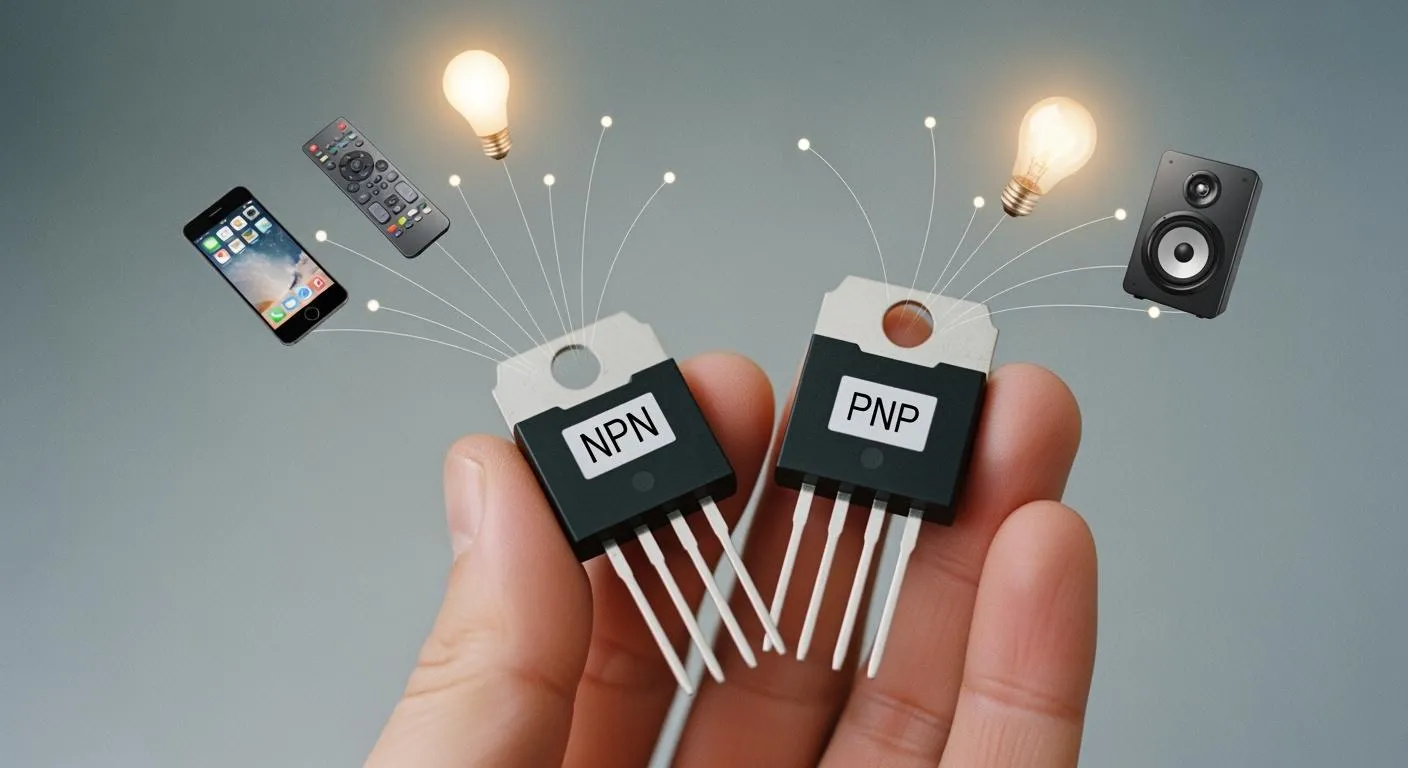
Think about the last time you used a TV remote or watched a small motor spin inside a toy. These everyday moments happen because of tiny parts called transistors. When you learn about npn transistor vs pnp, you start to see how electronics work from the inside out. You can spot problems faster and fix them more easily. You also make better choices when building or repairing electronics. Knowing how these transistors work helps you design biasing networks, remove bulky transformers, and boost the reliability of electronics. You use electronics in almost every part of your day, from your phone to your kitchen gadgets. Understanding these building blocks gives you more control over your electronics experience.
Key Takeaways
- NPN and PNP transistors are essential for controlling current in electronics. Understanding their differences helps you troubleshoot and design circuits effectively.
- NPN transistors switch current from collector to emitter and are ideal for high-speed applications. Use them in digital circuits for better performance.
- PNP transistors switch current from emitter to collector and are great for power management. They help control motors and stabilize voltage in devices.
- Always check current flow direction and voltage requirements when choosing between NPN and PNP transistors. This prevents wiring mistakes and ensures device functionality.
- Hands-on practice with NPN and PNP transistors enhances your understanding of circuits. Experimenting with these components builds your skills in electronics.
NPN Transistor vs PNP: Key Differences in Electronics
How Each Transistor Switches Current
When you compare npn transistor vs pnp, you see that the way each transistor switches current is very different. In an npn transistor, current flows from the collector to the emitter. You turn on the npn transistor by supplying current to the base from a microcontroller or another control circuit. This action lets the load connected to the collector connect to ground, which means the device can operate.
In a pnp transistor, current flows from the emitter to the collector. You turn on the pnp transistor by connecting the base to ground. This setup allows the load connected to the collector to receive power from the positive supply voltage. The difference in current flow comes from the polarity of the transistors. The npn transistor needs a positive base current to switch on, while the pnp transistor needs a negative base current.
Voltage requirements also set npn vs pnp apart. For an npn transistor, the base must be at a higher voltage than the emitter. For a pnp transistor, the base must be about 0.7 volts lower than the emitter. This voltage difference is important in circuit design. It tells you how to connect each transistor type in your project. For silicon pnp transistors, you usually bias the base negative compared to the emitter by about 0.7 volts. This contrasts with npn transistors, which source current through the base.
Tip: Always check the direction of current flow and voltage requirements before choosing between npn and pnp transistors for your circuit. This step helps you avoid wiring mistakes and ensures your device works as expected.
Speed, Power, and Application Roles
You often choose between npn transistor vs pnp based on speed and power needs. Npn transistors switch faster than pnp transistors. The reason is that npn transistors use electrons as charge carriers, which move faster than the holes used in pnp transistors. This higher electron mobility means npn transistors can turn on and off quickly. You see npn transistors in high-frequency circuits and digital electronics where fast switching is critical.
Npn transistors also handle more current and dissipate more power than pnp transistors. The larger emitter area in npn transistors allows higher current flow. This feature makes npn transistors more efficient in high-power applications, such as power amplifiers and voltage regulators.
Here is a quick comparison:
| Feature | NPN Transistor | PNP Transistor |
|---|---|---|
| Current Flow | Collector to Emitter | Emitter to Collector |
| Base Voltage | Higher than Emitter | Lower than Emitter |
| Charge Carrier | Electrons | Holes |
| Switching Speed | Faster | Slower |
| Power Handling | Higher | Lower |
| Common Use | High-speed, Digital | Power Management, Motor Control |
You often find npn transistors in digital circuits because they switch faster and have lower on-resistance. This quality improves efficiency and performance. Npn transistors are ideal for high-speed and high-current circuits, such as microcontroller outputs, logic gates, and switching power supplies.
Pnp transistors play a key role in power management. You see pnp transistors in voltage regulators, where they stabilize output voltage by managing changes in load and input voltage. Pnp transistors also appear in current mirror circuits, which set precise and stable current ratios. In power supply circuits, pnp transistors act as pass elements in voltage regulators, providing stable output voltages for sensitive electronic components.
-
NPN Transistor Application Highlights:
- High-speed switching in digital circuits
- Power amplifiers
- Voltage regulators
- High-frequency analog circuits
-
PNP Transistor Application Highlights:
- Voltage regulators for stable power
- Current mirror circuits
- Power supply pass elements
- Motor control circuits
Note: When you design or repair electronics, understanding npn vs pnp helps you pick the right transistor for speed, power, and control.
Nova Technology Company (HK) Limited stands out as a HiSilicon-designated solutions partner. The company specializes in chip-level solutions and system integration for advanced electronics. You can rely on Nova Technology for expertise in semiconductor design, IC integration, and application scenarios such as smart devices, industrial automation, and power management systems. Their partnership with HiSilicon ensures you get access to cutting-edge technology and reliable support for your projects.
By knowing the differences between npn transistor vs pnp, you can make smarter choices in your designs. You improve performance, reliability, and efficiency in everyday electronics.
NPN Transistor and PNP Transistor Basics
Structure and Schematic Symbols
You can think of a transistor as a tiny electronic switch. The npn transistor and pnp transistor have different internal structures, but both control the flow of current in circuits. The npn transistor has two layers of n-type material with a p-type layer in the middle. The pnp transistor has two layers of p-type material with an n-type layer in the middle. This difference changes how each transistor works.
Here is a table that shows the main structural differences:
| Feature | NPN Transistor | PNP Transistor |
|---|---|---|
| Structure | Negative-Positive-Negative (N-P-N) | Positive-Negative-Positive (P-N-P) |
| Internal Structure | P-layer between two N-layers | N-layer between two P-layers |
| Majority Charge Carriers | Electrons | Holes |
| Current Direction | Collector → Emitter | Emitter → Collector |
When you look at a circuit diagram, you can spot npn transistors and pnp transistors by their schematic symbols. The arrow on the symbol tells you the direction of current flow. For npn, the arrow points outward from the emitter. For pnp, the arrow points inward toward the base.
| Transistor Type | Arrow Direction | Current Flow Direction |
|---|---|---|
| NPN | Outward | Collector to Emitter |
| PNP | Inward | Emitter to Collector |
Tip: Remember, "NPN: Not Pointing iN" and "PNP: Pointing iN" to help you recall the arrow direction.
How to Identify NPN vs PNP in Circuits
You can identify npn transistors and pnp transistors in real circuits by checking the symbol and the way they connect to other components. Look for the arrow on the emitter leg. If the arrow points away from the base, you have an npn transistor. If the arrow points toward the base, you have a pnp transistor.
Here are some steps to help you:
- Find the transistor symbol on the schematic.
- Check the arrow direction on the emitter.
- Trace the connections. Npn transistors usually connect the emitter to ground. Pnp transistors often connect the emitter to the positive voltage supply.
- Look for part numbers on the actual transistor. You can search these numbers online to confirm if it is npn or pnp.
You will see npn transistors more often in digital circuits because they switch faster. Pnp transistors appear in power management and motor control circuits. When you understand these basics, you can read schematics and repair devices with more confidence.
Note: Always double-check the orientation before replacing a transistor. Using the wrong type can damage your circuit.
NPN vs PNP in Everyday Devices and Circuits

Common Uses in Sensors and Controls
You interact with npn transistors and pnp transistors every day, even if you do not see them. In sensors and control circuits, npn transistors often act as switches that connect the load to ground. You find npn transistors in digital sensors, microcontroller outputs, and logic circuits. These transistors allow current to flow from collector to emitter when you apply a positive voltage to the base. This setup is called low-side switching, and it is common in digital electronics.
On the other hand, pnp transistors play a key role in high-side switching. You see pnp transistors in control circuits for home appliances, where they sit between the power supply and the load. When you apply a negative voltage to the base, pnp transistors conduct current from emitter to collector. This function is essential for controlling motors, lights, and sensors in devices like washing machines, refrigerators, and air conditioners. Pnp transistors also appear in analog and industrial control systems, showing their versatility.
In battery-powered devices, pnp transistors help manage power efficiently. They reduce power consumption and extend battery life, which means you replace batteries less often and create less electronic waste.
Tip: Always check the ground and voltage requirements before choosing npn or pnp transistors for your circuit. This step prevents wiring mistakes and keeps your device safe.
Real-World Examples of PNP Transistors and NPN Transistors
You can spot npn transistors in automotive electronics. For example, they control current flow in car lighting and sensor systems. A small current at the base of an npn transistor lets a larger current flow from collector to emitter, amplifying signals and enabling precise control.
Pnp transistors are ideal for high-side switching in home appliances. They control motors, lights, and sensors by sourcing current from the power supply. In portable devices, pnp transistors improve battery management by reducing power use and increasing battery life.
Here is a table that shows how npn and pnp transistors contribute to energy efficiency:
| Transistor Type | Current Movement | Activation Voltage | Contribution to Energy Efficiency |
|---|---|---|---|
| NPN | Electrons | Positive | Faster switching in digital circuits |
| PNP | Holes | Negative | Lower power consumption in portable devices |
When you choose between npn and pnp transistors, you affect device reliability and performance. Npn transistors offer faster switching and better temperature stability, making them perfect for high-speed circuits. Pnp transistors provide positive logic alignment and can improve safety by reducing the risk of damage if a wire touches ground.
Common mistakes: Forgetting to check the ground, connecting the base with the wrong polarity, or swapping npn and pnp transistors without adjusting wiring can cause circuit failure.
By understanding where and why you use npn transistors or pnp transistors, you make smarter choices in your electronics projects.
You now know how npn transistors and pnp work in real circuits. When you choose npn, you get faster switching and better performance for digital projects. Npn transistors use electrons, so they move current quickly. Pnp helps with high-side switching and power control. You see npn transistors in most electronics, while pnp appears in power management. Try to spot npn and pnp in your devices. Hands-on practice with npn transistors and pnp will help you understand circuits better. Keep learning about npn and pnp to build your skills.
FAQ
What is the main function of npn transistors in electronics?
You use npn transistors to switch or amplify electrical signals. Npn transistors let current flow from the collector to the emitter when you apply a positive voltage to the base. This makes npn transistors ideal for digital circuits and fast switching.
How do npn transistors differ from pnp transistors?
Npn transistors allow current to flow from collector to emitter, while pnp transistors let current flow from emitter to collector. You activate npn transistors with a positive base voltage. Pnp transistors need a negative base voltage. Npn transistors switch faster and work better in digital circuits.
Why do you see npn transistors more often in digital devices?
You find npn transistors in digital devices because they switch faster and handle higher currents. Npn transistors use electrons as charge carriers, which move quickly. This speed makes npn transistors perfect for microcontrollers, logic gates, and other digital circuits.
Can you use npn transistors for both switching and amplification?
Yes, you can use npn transistors for switching and amplification. When you use npn transistors as switches, you turn devices on or off. When you use npn transistors as amplifiers, you boost weak signals. Npn transistors work well in both roles.
What is a bipolar junction transistor, and how does npn fit in?
A bipolar junction transistor is a type of transistor with three layers. Npn transistors are one kind of bipolar junction transistor. You use npn transistors to control current flow in many circuits. Npn transistors are common in amplifiers, switches, and digital logic.