2026 Buying Guide for the 3HCK5761-E-48.000 MHz Oscillator: Market Outlook, Sourcing, and Substitution Strategies
Expert guide on 2026 Buying Guide for the 3HCK5761-E-48.000 MHz Oscillator: Market Outlook, Sourcing, and Substitution Strategies. Technical specs, applications, sourcing tips for engineers and buyers.
Why the 48 MHz Oscillator Market Is Tighter Than You Think in 2026
If your bill of materials still treats a standard 48.000 MHz clock oscillator as a commodity you can order with a three‑week lead time, 2026 may deliver an uncomfortable surprise. The quartz‑based timing supply chain remains concentrated in ways that magnify every regional disruption. According to Mordor Intelligence, roughly 80% of high‑grade quartz blanks originate in Japan, a single‑point dependency that exposes oscillator manufacturers—and their customers—to geopolitical friction, logistics bottlenecks, and natural disasters [1]. When a blank shortage hits, the lengthy crystal‑growing and polishing cycles mean recovery is measured in months, not weeks.
That structural fragility hasn’t gone away. The Matric blog’s 2025 outlook documented persistent electronic component shortages, noting that even mature timing devices were seeing stretched deliveries as fabs prioritized higher‑margin lines [2]. By early 2026, the shortage picture has become more selective, but Melsonchip’s update warns that specific part numbers—especially those tied to a single quartz blank source—remain vulnerable to sudden allocation [3]. For a part like the 3HCK5761-E-48.000 MHz oscillator, that means your usual distributor may not have shelf stock when you need it, and the factory lead time could swing from eight weeks to sixteen weeks with little notice.
The takeaway is not panic but preparation. Understanding why this particular frequency node is pinched—and what alternatives exist—lets you build a sourcing plan that keeps production lines moving even when quartz blanks are scarce.
Inside the 3HCK5761-E: What Its Datasheet Tells You About Stability, Drive, and Footprint
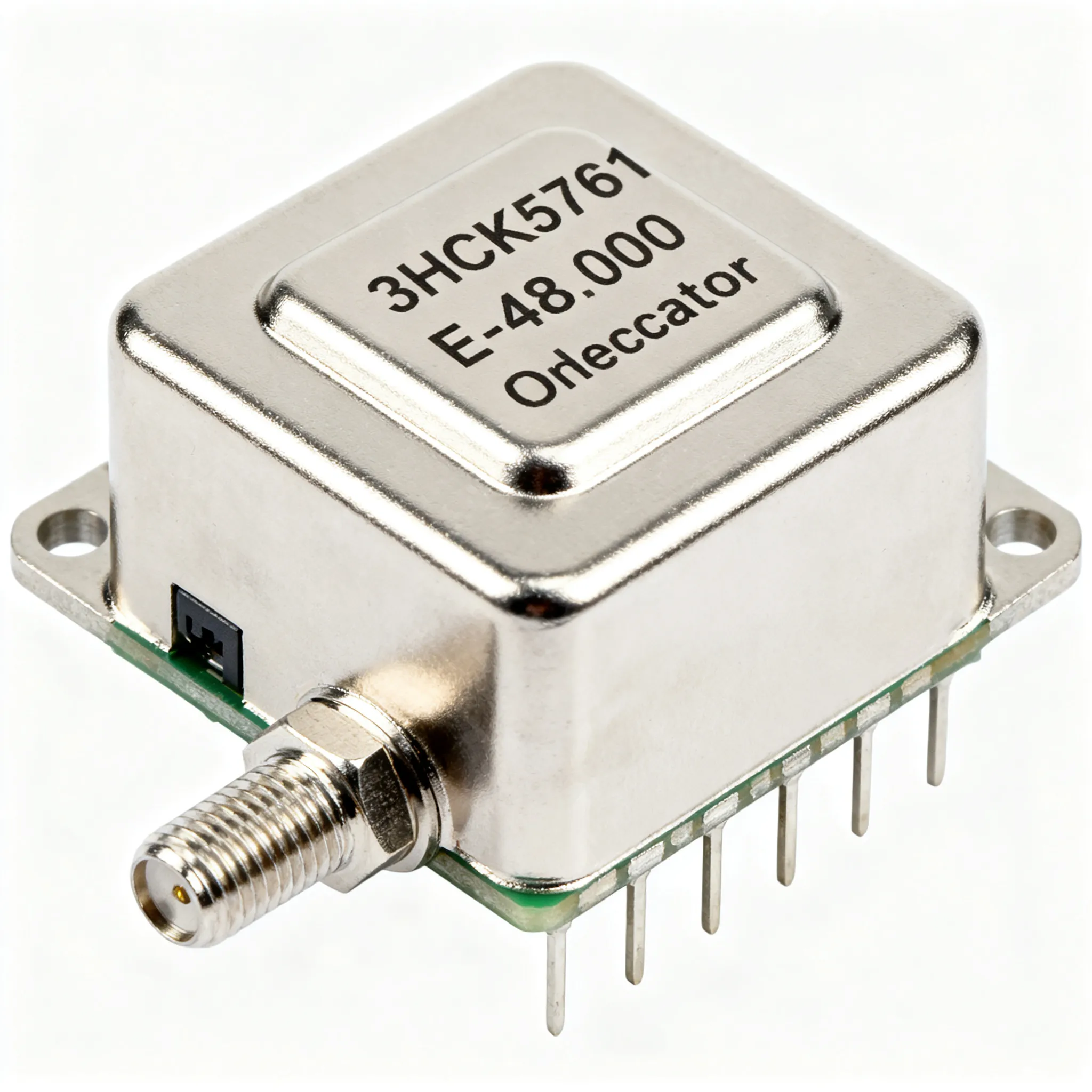
Before you can evaluate a substitute, you need a precise picture of what the 3HCK5761-E-48.000 brings to your design. While the full manufacturer datasheet is the only authoritative source, the part belongs to a well‑understood class of HCMOS clock oscillators. Engineers integrating a 48 MHz source will recognize the critical parameters from crystal oscillator design guidelines such as the EM9304 application note, which underscores the importance of drive level, load capacitance, and start‑up margin for reliable oscillation at this frequency [4].
Most standard‑clock oscillators in this category, as listed on Mouser, share a common footprint and electrical envelope [5]. The table below captures the typical specifications you should verify against the official datasheet for your specific variant.
| Parameter | Typical Value/Range | Notes |
|---|---|---|
| Nominal Frequency | 48.000 MHz | Fundamental mode, AT‑cut quartz or equivalent |
| Output Logic | HCMOS | Rail‑to‑rail swing; verify VOH/VOL against receiver thresholds |
| Supply Voltage (VDD) | 3.3 V or 5.0 V ±10% | Confirm variant; 3.3 V is most common in new designs |
| Frequency Stability | ±50 ppm (inclusive of initial tolerance, temperature, aging) | Some versions offer ±25 ppm; tighter specs cost more |
| Operating Temperature Range | -20 °C to +70 °C (commercial) or -40 °C to +85 °C (industrial) | Industrial grade recommended for outdoor or fanless enclosures |
| Package Dimensions | 5.0 × 7.0 mm or 3.2 × 2.5 mm SMD | Standard 4‑pad layout; check height profile for dense boards |
| Rise/Fall Time | 5 ns typical (10%–90% into 15 pF load) | Faster edges improve jitter but increase EMI |
| Start‑up Time | 5 ms max | Critical for power‑gated or burst‑mode systems |
| Supply Current | 15–25 mA (no load, 3.3 V) | Higher at 5 V; confirm in‑circuit measurement |
| Standby Function | Often available (pin 1 or pin 2 tri‑state) | Useful for power‑saving; verify logic polarity |
Tip: When reviewing the datasheet, pay close attention to the stability budget. A ±50 ppm rating that includes 10‑year aging is far more valuable than a ±25 ppm initial tolerance that drifts quickly. Also confirm the output drive capability—many HCMOS oscillators are specified with a 15 pF load, and exceeding that can degrade rise time and jitter.
These parameters form the baseline for any substitution. If you can match frequency, stability, supply voltage, output type, and footprint, you are already 90% of the way to a drop‑in replacement.
When the 3HCK5761-E Isn’t on the Shelf: Quartz Alternatives, MEMS Swaps, and Field‑Programmable Options
The 3HCK5761-E-48.000 may be your first choice, but a selective shortage doesn’t have to halt your production. Three categories of alternatives can fill the gap: other quartz‑based oscillators from broad‑line distributors, MEMS oscillators fabricated in standard semiconductor fabs, and field‑programmable devices that let you dial in the exact frequency and output format on demand.
Quartz alternatives are the most straightforward. Distributors like Future Electronics and Mouser stock dozens of 48.000 MHz HCMOS oscillators in the same package sizes, often with equivalent or better stability [6]. The catch is that during a quartz blank crunch, all quartz oscillators may share the same extended lead times.
MEMS oscillators break that dependency. SiTime’s MHz portfolio, for example, is built in CMOS fabs across North America, Europe, and Asia, completely bypassing the quartz blank supply chain [7]. The MEMS oscillators market grew from USD 870 million in 2025 to nearly USD 937 million in 2026 and is forecast to reach USD 1.47 billion by 2032, driven partly by buyers seeking supply‑chain resilience [8]. MEMS parts like the SiT8008 offer the same footprint, pinout, and HCMOS output as a quartz oscillator, often with better shock and vibration tolerance.
Field‑programmable oscillators from Microchip add another layer of flexibility. Using the ClockWorks online tool, you can configure a blank device to 48.000 MHz, select the output type, and receive samples within 48 hours [9]. This approach is ideal for prototyping or bridging a shortage while you qualify a permanent second source.
Cost is always a factor. The anypcba price guide notes that standard quartz oscillators in the 48 MHz range are among the most economical timing solutions, but MEMS oscillators have closed the gap significantly in high‑volume applications, and the premium for programmability is often offset by inventory simplification [10].
| Comparison Metric | Quartz Alternative (e.g., Epson SG‑8002) | MEMS Oscillator (e.g., SiTime SiT8008) | Field‑Programmable (e.g., Microchip DSC1001) | Selection Criteria & Failure Boundary |
|---|---|---|---|---|
| Frequency Stability | ±50 ppm (standard); ±25 ppm available | ±50 ppm (standard); ±25 ppm available | ±25 ppm to ±50 ppm depending on configuration | Match your system’s timing budget; tighter than ±50 ppm may require MEMS or quartz with aging specs |
| Typical Lead Time (2026) | 8–16 weeks (quartz blank dependent) | 4–8 weeks (semiconductor fab cycle) | Samples in 48 h; volume in 2–4 weeks | If lead time exceeds your safety stock, MEMS or programmable can bridge the gap |
| Drop‑in Compatibility | High—same footprint, pinout, HCMOS levels | Very high—industry‑standard packages, pin‑compatible | High—configurable to match existing layout | Always verify VDD, output drive, and enable/disable polarity |
| Relative Cost (10k volume) | $ (baseline) | $–$$ (competitive at volume) | $$ (premium for flexibility, but reduces inventory SKUs) | Total cost of ownership includes qualification and inventory holding |
| Qualification Effort | Low—similar technology, minor datasheet comparison | Low to medium—validate start‑up time, jitter, and EMI signature | Low—same silicon platform, just different configuration | Perform a quick bench validation: power‑on, frequency counter, eye diagram |
| Supply‑Chain Resilience | Low—dependent on Japanese quartz blank supply | High—multi‑fab, multi‑region CMOS manufacturing | Medium—silicon supply but configurable stock | Dual‑source with MEMS to decouple from quartz disruptions |
MEMS oscillators are no longer exotic. Their sustained growth and adoption in automotive and industrial applications confirm they meet stringent reliability requirements. For a 48 MHz clock, the SiT8008 or SiT8208 can often be treated as a form‑fit‑function replacement, provided you confirm the drive strength and any power‑supply sequencing differences.
How to Buy Smart in a Selective Shortage: Authorized Distribution, Lead‑Time Checks, and Substitution Approval
Procurement in 2026 demands a proactive rhythm. Relying on a single distributor’s stock level the week before production is a recipe for line‑down events. Instead, build a sourcing workflow that treats the 3HCK5761-E-48.000 as a managed risk.
Start by verifying the exact manufacturer part number, including any suffix that denotes packaging, temperature range, or stability grade. A single digit difference can change the supply voltage or output format. Then check live inventory at authorized distributors. Mouser and Future Electronics both offer real‑time stock visibility and parametric filtering that lets you quickly identify in‑stock alternatives with the same footprint and electrical specs [11].
Lead‑time signals are your early‑warning system. The Melsonchip 2026 update highlights that selective shortages often appear first as quietly extended lead times on specific frequency‑and‑package combinations [3]. The Matric blog reinforces that buyers should track not just the quoted weeks but also the trend—if a part moves from 8 to 12 weeks in a single quarter, it’s time to trigger your second‑source qualification [2].
Traceability is non‑negotiable. While standard clock oscillators are less frequently counterfeited than high‑value semiconductors, gray‑market parts can carry incorrect marking, out‑of‑spec performance, or moisture‑damaged packaging. Always request a certificate of conformance and full supply‑chain traceability from your distributor. Franchised partners provide this as a matter of course.
The table below distills the key actions into a repeatable procurement checklist.
| Action | Tool / Resource | Why It Matters |
|---|---|---|
| Confirm exact MPN and datasheet revision | Manufacturer website, Mouser product page | Prevents ordering a 5 V part for a 3.3 V rail, or a commercial‑temp device for an industrial enclosure |
| Check live stock at ≥2 authorized distributors | Mouser, Future Electronics | Reveals real‑time availability; a single distributor may show zero while another has 2,000 pieces |
| Monitor lead‑time trends monthly | Distributor portals, Melsonchip and Matric updates | Catches tightening supply before allocation hits; gives engineering time to qualify alternatives |
| Pre‑qualify a MEMS or programmable second source | SiTime, Microchip ClockWorks | Ensures a drop‑in replacement is already validated, not rushed through qualification under duress |
| Request full traceability documentation | Distributor quality portal | Eliminates gray‑market risk and supports ISO 9001 audit trails |
| Engage engineering early for substitution approval | Internal change‑control process | Shortens the time from “stock‑out alert” to “new part on the line” |
Key Takeaway: The most successful buyers in 2026 treat the 3HCK5761-E-48.000 not as a single part number but as a functional requirement—48.000 MHz, HCMOS, ±50 ppm, 3.3 V, 5×7 mm—that can be met by multiple qualified sources. That mindset shift, combined with early engineering collaboration, turns a potential shortage into a manageable sourcing exercise.
Your 3HCK5761-E Sourcing Questions Answered
Q: What are the exact electrical specifications of the 3HCK5761-E-48.000 MHz oscillator?
The 3HCK5761-E-48.000 is a fixed‑frequency clock oscillator with a nominal output of 48.000 MHz. Typical configurations use HCMOS output logic, a supply voltage of 3.3 V or 5.0 V, and frequency stability of ±50 ppm over the commercial or industrial temperature range. Package sizes are commonly 5.0×7.0 mm or 3.2×2.5 mm SMD. Because suffixes and custom variants exist, always confirm the exact parameters—especially supply voltage, stability grade, and enable/disable polarity—against the official datasheet for your specific part number.
Q: Can I replace the 3HCK5761-E with a MEMS oscillator without redesigning my board?
In most cases, yes. MEMS oscillators such as the SiTime SiT8008 are designed to be drop‑in compatible with standard quartz oscillator footprints and pinouts. They offer the same HCMOS output levels and supply voltage options. Before committing, verify the MEMS part’s drive strength, start‑up time, and any subtle differences in output impedance or power‑supply rejection. A quick bench test—checking frequency, rise time, and supply current—will confirm compatibility without a board spin.
Q: What lead times should I expect for this oscillator in 2026, and how can I mitigate shortages?
Lead times for quartz‑based 48 MHz oscillators can stretch to 12–16 weeks when quartz blank supply tightens, as highlighted by the Mordor Intelligence report on supply‑chain concentration [1]. Mitigation starts with holding buffer stock equal to at least one lead‑time cycle. Next, qualify a second source—either another quartz vendor or a MEMS alternative—so you can pivot quickly. Monitor authorized distributors like Mouser and Future Electronics for real‑time inventory, and set up automated alerts for the part number.
Q: Is there a risk of counterfeit 3HCK5761-E parts in the market?
Standard clock oscillators are counterfeited less often than high‑value ICs, but the risk is not zero. Gray‑market parts may carry incorrect frequency markings, substandard stability, or moisture‑damaged packaging that leads to early failures. The best defense is to purchase exclusively from franchised distributors and insist on full traceability documentation, including the manufacturer’s certificate of conformance. If a deal seems too good to be true, it probably is.
Q: How do I cross‑reference the 3HCK5761-E to equivalent parts from other manufacturers?
Use the parametric search tools on Mouser or Future Electronics, filtering by frequency (48.000 MHz), stability (±50 ppm or better), package size, supply voltage, and output type (HCMOS). Common alternatives include the Epson SG‑8002 series, the SiTime SiT8008 MEMS oscillator, and the Microchip DSC1001 field‑programmable oscillator. Once you have a shortlist, compare the full datasheet parameters—especially start‑up time, output drive, and standby current—to ensure they match your design’s requirements.
Navigating the 2026 oscillator market requires a blend of engineering insight and procurement agility. By treating the 3HCK5761-E-48.000 as a functional specification rather than a single‑source part, you can keep your production lines running even when quartz supply chains tighten. For mixed BOMs and flexible MOQ sourcing across multiple timing devices, visit IC-Online to explore inventory options and connect with authorized distributors who understand the realities of today’s selective shortages.
References & Further Reading
- Oscillator Market Size, Trends, Growth Drivers & Share 2025–2030 – Mordor Intelligence
- Electronic Component Shortages: 2025 Outlook – Matric Blog
- 2026 Electronic Component Shortage Update for Buyers – Melsonchip
- EM9304: 48 MHz XTAL Selection Application Note – EM Microelectronic
- Standard Clock Oscillators – Mouser Electronics
- Buy Oscillators Products Online – Future Electronics
- MHz Oscillators – SiTime
- MEMS Oscillators Market – Global Forecast 2026–2032 – Research and Markets
- Oscillators – Microchip Technology
- Crystal Oscillator Prices: A Comprehensive Guide for Buyers – AnyPCBA
- Oscillators – Mouser Electronics