The Evolution of Service Supply Chain Management and NOVA Technology's Role in Optimizing Electronic Component Distribution
Service supply chain management has changed how industries work. It uses smart plans to handle rising needs. In recent years, warehouses in busy cities earned 11.1% yearly returns. This is much better than less busy areas. This shows the need for better tech distribution. But distributors face problems like changing demand and poor inventory control. NOVA Technology solves these problems with smart tools. They make distribution easier and faster. Their skills help businesses keep up with changes and work better.
Service supply chain management has changed how industries work. It uses smart plans to handle rising needs. In recent years, warehouses in busy cities earned 11.1% yearly returns. This is much better than less busy areas. This shows the need for better tech distribution. But distributors face problems like changing demand and poor inventory control. NOVA Technology solves these problems with smart tools. They make distribution easier and faster. Their skills help businesses keep up with changes and work better.
Key Takeaways
-
Service supply chains have changed from strict plans to flexible systems.
-
Digital tools and live data help businesses handle stock better.
-
These tools also help meet customer needs faster and easier.
-
NOVA Technology improves tech distribution with smart tools for accuracy and speed.
-
Predictive tools and machine learning help guess demand and improve supply chains.
-
Learning and new ideas help distributors stay ahead in a fast market.
The Evolution of Service Supply Chain

From Old Models to Service-Based Supply Chains
Switching from old supply chains to service-based ones is a big change. Old models used fixed plans and struggled with market shifts. Service-based chains are flexible and quick to adjust. They help businesses meet changing customer needs better.
|
Feature |
Old Supply Chain |
Service-Based Supply Chain |
|---|---|---|
|
Approach |
Fixed plans for demand |
|
|
Process |
Separate manufacturing steps |
Connected services and value streams |
|
Value |
Based on fixed actions |
Created through dynamic service activities |
|
Market Reaction |
Slow to adapt |
Fast response to demand changes |
This shift shows the focus on customer happiness and efficiency. Businesses now use data to make smarter decisions. Tools like logistic regression help find useful patterns in complex data.
-
Old systems cut costs but lacked flexibility.
-
New chains focus on speed, customization, and constant improvement.
-
Resiliency is now key to handling global supply chain problems.
Important Steps in Supply Chain Improvement
Supply chains have improved a lot thanks to better tech and planning. Key steps include better delivery, higher quality, and lower costs. These show the push for smoother and more effective networks.
|
Performance Measure |
What It Tracks |
|---|---|
|
How often suppliers deliver on time. |
|
|
Quality |
If suppliers meet quality standards. |
|
Cost Efficiency |
How well suppliers balance cost and performance. |
Money-related measures are also important for improving supply chains. Things like stock levels, demand, and lead times help businesses plan better. These numbers help reduce waste and match operations to market needs.
|
Financial Measure |
What It Helps With |
|---|---|
|
Current Stock |
Shows inventory to guide buying decisions. |
|
Total Demand |
Tracks demand over time to plan orders. |
|
Expected Lead Time |
Predicts how long new stock will take to arrive. |
The results of these improvements are clear. For example, 68% of leaders improved processes, boosting revenue by 55%. Also, 53% optimized working capital, and 48% cut costs significantly.
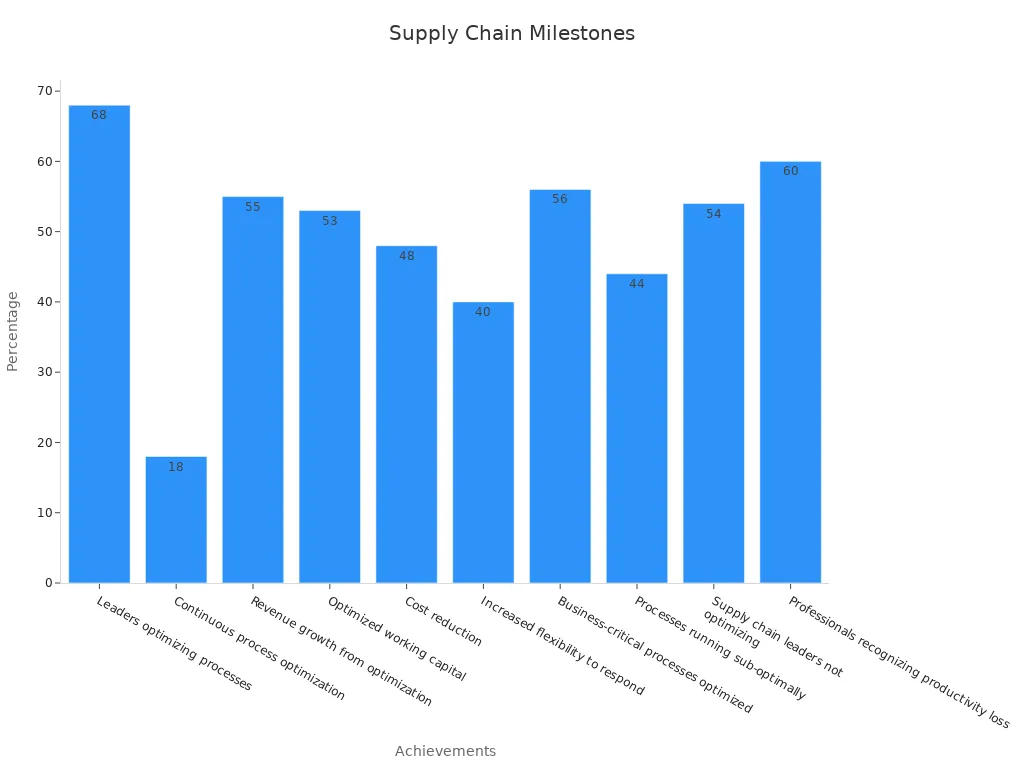
These successes highlight the need for ongoing learning and adapting in supply chain management.
How Digital Tools Help Service Supply Chains
Digital tools have changed service supply chains, making them faster and smarter. Advanced tech helps companies manage inventory, improve operations, and use resources better.
|
Measure |
What It Tracks |
|---|---|
|
Tracks stock to save money and avoid waste. |
|
|
Supply Chain Efficiency |
Finds areas to improve, cutting costs and time. |
|
Operational Efficiency |
Simplifies processes to boost productivity. |
|
Process Cycle Times |
Measures time to spot delays and fix issues. |
|
Resource Use |
Tracks usage to reduce waste and improve allocation. |
|
Production Output and Quality |
Checks if products meet demand and quality standards. |
Digital tools also allow real-time data analysis. This helps businesses react quickly to market changes, especially in tech where demand shifts fast.
Cloud platforms and IoT devices improve supply chain visibility. They help teams work together smoothly. This boosts efficiency, encourages innovation, and supports learning in the industry.
Challenges in Technology Distribution
Growing Need for Electronic Parts
The need for electronic parts is growing fast. This is because of new technology and more smart devices. Market data shows big growth in size and sales over time:
|
Year |
Volume (Million Units) |
Growth (%) |
|
|---|---|---|---|
|
2022 |
293.9 |
5,381.6 |
5.2 |
|
2030 |
477.7 |
N/A |
6.4 |
This growth shows why better delivery systems are needed. Companies must predict future needs to plan their stock. Without this, they may run out of items or have too much, causing problems and unhappy customers.
Problems in Supply Chains
Supply chains often face problems in tech distribution. The Global Supply Chain Pressure Index (GSCPI) shows big changes, especially in tech. These problems come from fast tech changes and trade rules. The table below explains these issues:
|
Evidence Type |
What It Shows |
|---|---|
|
GSCPI |
Tracks problems using cost changes. |
|
Volatility |
Big changes in GSCPI numbers. |
|
Sector Impact |
Tech has the most problems. |
|
Skewness |
Shows frequent extreme disruptions. |
These problems show why companies must learn from past mistakes. They need better plans to predict needs and handle risks.
Using Real-Time Data to Fix Problems
Real-time data helps solve supply chain issues. It helps companies manage stock and react to changes quickly. Important measures include:
-
Time to Sell: Tracks how fast items sell.
-
Order Fill Rate: Shows how many orders are on time.
-
Perfect Order Rate: Checks for error-free deliveries.
-
On-Time Delivery: Measures how reliable deliveries are.
Using real-time data helps companies plan better and waste less. It also keeps customers happy and encourages new ideas in the industry.
NOVA Technology's Contributions to Supply Chain Optimization
NOVA Technology's Expertise in Technology Distribution
NOVA Technology is a top name in technology distribution. They use smart tools and strategies to solve modern supply chain problems. Their focus is on building fast, accurate, and flexible networks. By using data, they help distributors make better choices and improve their work.
The role of distributors has changed a lot over time. NOVA Technology helps with this change by offering solutions for managing stock, improving delivery, and predicting demand. This ensures distributors can handle more orders while staying reliable.
NOVA Technology does more than just improve operations. They focus on learning and creating new ideas. This helps distributors adjust to market changes and stay ahead in a fast-moving industry.
Tools and Strategies for Optimizing Distribution
NOVA Technology uses many tools and strategies to make supply chains better. They combine digital tech, smart data tools, and real-time updates to improve decisions and work faster. Some key strategies are:
-
Forecasting and Planning: They use smart tools to guess demand and manage stock. This reduces waste and ensures products arrive on time.
-
Digital Integration: Cloud systems and IoT devices help teams see and share supply chain data easily.
-
Advanced Process Control: Their special tools improve product quality and speed up production.
The table below shows how NOVA Technology’s tools improve technology distribution:
|
Metric Type |
Description |
|---|---|
|
Innovative metrology solutions |
Offers advanced tools for making and controlling semiconductor products. |
|
Advanced process control |
Boosts product quality and speeds up production for tech items. |
These tools not only make work smoother but also bring new ideas and flexibility to the supply chain.
Real-World Examples of NOVA Technology's Impact
NOVA Technology’s tools have made a big difference in real-world cases. Their advanced solutions have improved how technology is distributed. Here are some examples:
-
Semiconductor Manufacturing: Their tools help factories make better products faster and with fewer mistakes.
-
Continuous Innovation: They mix hardware and software to improve processes and keep up with new tech.
|
Metric Type |
Description |
|---|---|
|
High-performance metrology |
Gives useful data to improve semiconductor production. |
|
State-of-the-art solutions |
Combines tools and software to make products faster and better. |
|
Continuous innovation |
Keeps technology distribution updated with the latest advancements. |
These examples show how NOVA Technology helps distributors succeed. Their focus on new ideas and learning helps clients handle challenges and stay competitive.
Broader Implications for the Industry
Making Operations Better and Cutting Costs
Improving supply chains has changed how distributors work. It brings clear benefits to many industries. Using predictive analytics, distributors can better match supply with demand. This reduces waste and helps them earn more money. Managing resources well avoids having too much or too little stock. It ensures distributors keep just the right amount of inventory.
Smart ideas like planning delivery routes and cross-docking save money. Combining shipments and picking cheaper carriers makes deliveries smoother. Automated tools and energy-saving warehouses also make work faster. These changes lower costs and improve how businesses run.
Tip: Using data tools helps distributors improve their work. It lowers costs and makes them stronger against problems like supplier issues or sudden demand changes.
|
Strategy/Component |
Economic Indicator |
|---|---|
|
Inventory Turnover Analysis |
Keeps stock at the right levels |
|
Optimize Routes |
Finds cheaper ways to deliver goods |
|
Consolidate Shipments |
Cuts down on shipping costs |
|
Automated Systems |
Makes warehouse work faster |
|
Energy Efficiency |
Saves money on warehouse utilities |
These updates show why planning and learning are so important. They help distributors stay competitive in changing markets.
Making Customers Happier with New Ideas
New ideas in supply chain management make customers happier. Distributors now focus on keeping products in stock. This ensures customers can always find what they need. Careful quality checks keep products reliable, building trust with buyers. Fast deliveries are now a key part of good service. Distributors use technology to meet customer expectations.
|
Metric |
Description |
|---|---|
|
Keeps items in stock to avoid running out. |
|
|
Product Quality |
Checks products to make sure they are good. |
|
Delivery Times |
Ensures products arrive on time for happy customers. |
By using smart planning tools and live data, distributors can predict what customers want. They can also adjust quickly to changes in the market. This way of working not only adds value but also builds strong customer relationships. Happy customers often return, helping businesses grow.
The Future of Service Supply Chain Management
The future of supply chains depends on predictive analytics and machine learning. These tools help distributors guess demand, manage stock, and improve their work. Models like regression and time series analysis show market trends. This helps distributors plan better.
Note: Lifecycle modeling shows how products change over time. It helps distributors plan for seasonal or new product needs.
|
Method |
Type |
Best Use Case |
Key Challenge |
|---|---|---|---|
|
Moving Averages |
Quantitative |
Smooths short-term trends |
Slow to react to sudden changes |
|
Regression Analysis |
Quantitative |
Links demand to outside factors |
Needs strong data connections |
|
Machine Learning Models |
Quantitative |
Handles fast-changing data |
Needs lots of data and setup |
|
Time Series Analysis |
Quantitative |
Uses steady past data |
Struggles with quick changes |
Forecasting with past data assumes demand will repeat patterns. This helps distributors make smart choices. It keeps distribution valuable in a fast-changing world. As tech improves, distributors must keep learning. This helps them face challenges and find new chances to grow.
The way service supply chains work has changed a lot over time. Global trade, unpredictable markets, and new customer needs have pushed businesses to improve. Old systems are being replaced by smarter ones that use data and adjust quickly. Today, successful supply chains focus on speed and flexibility. Tools like big data and AI help track shipments and predict future needs. These tools make sure distributors can keep up with fast-changing demands.
NOVA Technology plays an important role in solving tech distribution problems. They use smart tools like AI and custom solutions to help distributors work better. Their methods improve accuracy and save money. NOVA also focuses on safety and using AI responsibly, which builds trust in their systems.
To grow in the future, businesses must keep learning and trying new ideas. As technology gets better, distributors need to stay flexible to compete. By using tools like predictive analytics and encouraging learning, the industry can become stronger and more efficient. This will help ensure success for years to come.
FAQ
What do distributors do in supply chain management?
Distributors connect manufacturers with customers. They move products efficiently. They manage stock, plan delivery routes, and predict demand. This keeps the distribution process smooth and reliable.
How does NOVA Technology make technology distribution better?
NOVA Technology uses smart tools like predictive analytics and IoT devices. These tools share data instantly, manage stock better, and speed up decisions. Their solutions help distributors adjust to changes and work more efficiently.
Why is real-time data useful in distribution?
Real-time data helps track stock, shipments, and demand changes quickly. It reduces delays, cuts waste, and keeps customers happy. It also helps make smarter decisions and use resources wisely.
How does learning improve supply chains?
Learning helps improve supply chains over time. By studying past results and using new tech, distributors can improve plans. This keeps them competitive and ready for market changes.
What problems do distributors face in technology distribution?
Distributors deal with supply chain issues, changing demand, and stock problems. Solving these needs good planning, real-time data, and creative ideas. This ensures smooth delivery and happy customers.