Series Parallel Capacitor Secrets Most Beginners Miss
Series parallel capacitor setups impact capacitance, voltage, and reliability. Avoid common mistakes and optimize your electronics projects with these insights.
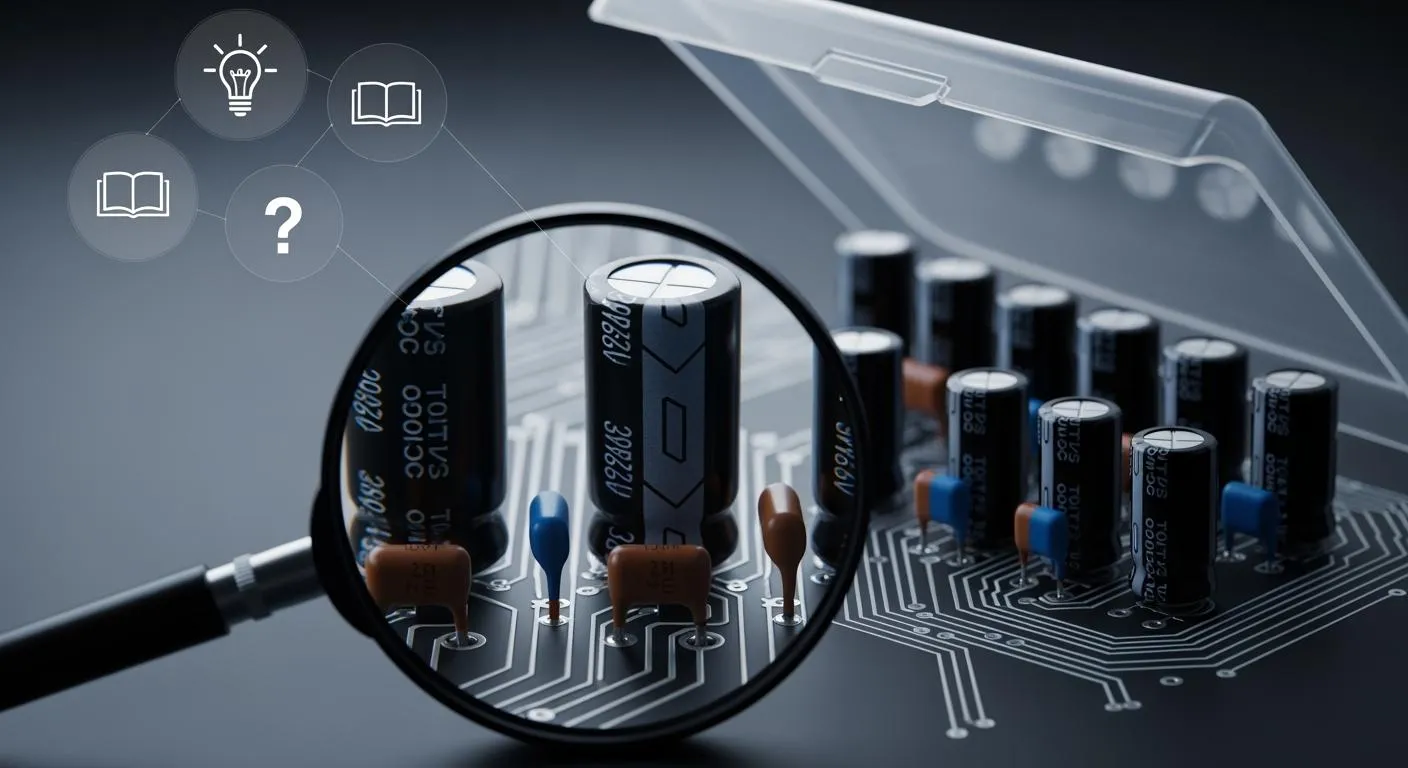
You open your first electronics kit and stare at the circuit diagram. Multiple capacitors sit in both series and parallel arrangements, leaving you puzzled. Many beginners feel uncertain when they see these combinations. You need to understand how a capacitor behaves in different setups because this passive electronic component plays a key role in filtering, timing, and stabilizing circuits. A small mistake—like overlooking voltage ratings or not checking for proper installation—can lead to circuit failure. If you want your series parallel capacitor projects to work reliably, you must avoid these common slip-ups and truly grasp how each capacitor affects your design.
Key Takeaways
- Understand that capacitors in series decrease total capacitance. Use the reciprocal formula to calculate total capacitance accurately.
- Capacitors in parallel increase total capacitance. Simply add the capacitance values together to find the total.
- Pay attention to voltage ratings. Always choose capacitors rated higher than your circuit's voltage to prevent failures.
- Mixing different capacitor types can lead to performance issues. Match types based on tolerance and voltage needs for reliable circuits.
- Use simulation tools to test circuit designs. This helps predict performance and avoid costly mistakes before building.
Series Capacitor Basics

Series Capacitor Behavior
When you connect capacitors in series, the total capacitance decreases. This happens because each capacitor acts like a barrier to the flow of charge. In a series arrangement, the charge must pass through every capacitor, so the overall ability to store charge drops. The voltage across the circuit is the sum of the voltages across each capacitor. If you use a parallel plate capacitor in a series chain, you see the same effect. The voltage drop across each capacitor depends on its capacitance. Smaller capacitance means a larger voltage drop, while larger capacitance means a smaller drop.
Tip: Series capacitors are common in circuits where you need to handle higher voltages. You can use them to split voltage across multiple capacitors, protecting each one from exceeding its voltage rating.
Series Capacitance Formula
You calculate the total capacitance in a series circuit using a special formula. The reciprocal of the total capacitance equals the sum of the reciprocals of each individual capacitor. This formula works for any number of capacitors in series.
| Formula for Total Capacitance in Series |
|---|
| [\dfrac{1}{C_S} = \dfrac{1}{C_1} + \dfrac{1}{C_2} + \dfrac{1}{C_3} ] |
For example, if you connect three capacitors—2F, 4F, and 6F—in series, the total capacitance is about 0.92F. This value is less than the smallest individual capacitor. You can use this formula for parallel plate capacitor calculations as well.
Voltage and Charge in Series
All capacitors in a series circuit share the same charge. The voltage divides across each capacitor based on its capacitance. Smaller capacitors get a larger share of the voltage. You can see this in the table below:
| Aspect | Explanation |
|---|---|
| Charge distribution | Each capacitor holds the same charge, no matter its capacitance. |
| Practical example | C1=2F, C2=4F, C3=6F, DC voltage=10V: |
| Total capacitance | 0.92F |
| Charge (Q) | Q = C × V = 0.92 × 10 = 9.2C |
| Voltage distribution | Voltage across each capacitor is V = Q / C. The sum equals the source voltage (10V). |
- All capacitors in series hold the same charge.
- The voltage drop across each capacitor depends on its capacitance.
- The sum of all voltage drops equals the total circuit voltage.
- In a circuit with two capacitors of equal value, the voltage divides equally.
- If you use capacitors with different values, the smaller one gets a bigger voltage drop.
For instance, if you connect a 470 nF and a 1 µF capacitor in series across a 12V supply, the 470 nF capacitor experiences a voltage drop of 8.16V, while the 1 µF capacitor gets 3.84V. This principle helps you design circuits that use parallel plate capacitors for voltage division and protection.
Parallel Capacitor Basics
Parallel Capacitance Increase
When you connect capacitors in parallel, the total capacitance increases. This happens because the positive plates of all capacitors connect together, as do the negative plates. This setup makes the capacitors act like one larger capacitor with a bigger effective plate area. More plate area means more ability to store energy.
Think of it like stacking parallel plate capacitors side by side. The total plate area grows, so the circuit can store more charge at the same voltage.
You calculate the total capacitance in parallel by simply adding each capacitor’s capacitance:
To find the equivalent capacitance (Cp) of a parallel network, the total charge (Q) stored by the network is the sum of the charges on each capacitor: Q = Q1 + Q2 + Q3. Using the relation Q = CpV for the entire network and Q1 = C1V, Q2 = C2V, Q3 = C3V for individual capacitors, we derive the formula:
Cp = C1 + C2 + C3
For example, if you connect three capacitors of 2F, 4F, and 6F in parallel, the total capacitance becomes 12F. This value is larger than any single capacitor in the group.
Voltage and Charge in Parallel
In a parallel circuit, all capacitors share the same voltage. The positive plates connect to the same point, and the negative plates connect to another, so the voltage across each capacitor stays equal.
| Aspect | Explanation |
|---|---|
| Voltage distribution | Each capacitor experiences the same voltage drop. |
| Charge storage | Charge on each capacitor depends on its capacitance: Q = C × V. |
| Practical example | For a 12V supply with 470 nF and 1 µF capacitors in parallel: |
| - 470 nF stores Q = 470nF × 12V = 5.64 µC | |
| - 1 µF stores Q = 1µF × 12V = 12 µC |
Larger capacitors store more charge under the same voltage. This principle helps you design circuits where you want to increase energy storage or smooth voltage fluctuations.
Common Uses for Parallel Capacitors
You often use parallel capacitors to increase total capacitance in circuits that need stable or higher energy storage. This setup improves filtering and reduces voltage ripple in power supplies.
Some typical applications include:
- Decoupling and Bypass Networks: Capacitors supply quick bursts of current and block high-frequency noise, protecting sensitive digital circuits.
- Voltage Smoothing: In DC power supplies, parallel capacitors stabilize output voltage by absorbing sudden changes.
- Filtering: They remove unwanted high-frequency signals, improving audio and signal quality.
- Power Supplies: Parallel capacitors help reduce ripple and improve voltage stability.
- Motor Drivers: Sharing current among capacitors enhances performance.
- Audio Circuits: They block DC components and isolate noise for clearer sound.
Understanding how capacitors behave in parallel helps you choose the right combination for your circuit’s energy storage and filtering needs. Using parallel plate capacitors in this way lets you tailor capacitance and voltage handling precisely.
Series Parallel Capacitor Configurations

Combining Series and Parallel
You often face circuits that mix both series and parallel capacitor arrangements. This combination lets you fine-tune the total capacitance and energy storage in your circuit. When you connect capacitors in parallel, you increase the total capacitance. This setup boosts current handling and energy storage, which is ideal for power supply filtering and energy-demanding applications. In contrast, connecting capacitors in series decreases the total capacitance but raises the voltage tolerance. This feature makes series arrangements suitable for high-voltage circuits.
When you combine both series and parallel, you gain the benefits of each. You can design a circuit that handles high voltage and stores more energy at the same time. This flexibility is essential for advanced electronics, such as integrated circuits, power management modules, and signal processing systems. You can use simulation tools to predict how these combinations will affect your circuit before building it.
Calculating Total Capacitance
To find the total capacitance in a mixed series parallel capacitor network, you need a step-by-step approach. Follow these steps to simplify your calculations:
- Identify all groups of capacitors that are only in series or only in parallel.
- Calculate the equivalent capacitance for each group.
- Replace each group with its equivalent value in your circuit diagram.
- Repeat the process until you have a single equivalent capacitance for the entire circuit.
Let’s look at a practical example:
Suppose you have the following arrangement:
- Two capacitors (C1 = 2 µF, C2 = 4 µF) in series.
- This series group is connected in parallel with a third capacitor (C3 = 6 µF).
Step 1: Calculate the series group: [ \frac{1}{C_{series}} = \frac{1}{2} + \frac{1}{4} = \frac{3}{4} ] So, [ C_{series} = \frac{4}{3} \approx 1.33,\mu F ]
Step 2: Add the parallel capacitor: [ C_{total} = C_{series} + C_3 = 1.33,\mu F + 6,\mu F = 7.33,\mu F ]
This method works for any series parallel capacitor network. You can use simulation software to check your results and visualize energy storage and voltage distribution.
Tip: Always double-check your calculations, especially when working with complex networks. Simulation tools can help you avoid costly mistakes in real-world circuits.
Circuit Behavior Changes
When you mix series and parallel capacitors, you change how your circuit handles voltage, current, and energy. Here are some key effects:
- In parallel, the total capacitance increases. This setup lets your circuit store more energy and handle higher currents. It works well for power supply filtering and energy storage.
- In series, the total capacitance decreases. This arrangement increases the voltage tolerance of your circuit, making it safer for high-voltage applications.
- The equivalent capacitance in a parallel group is always greater than the largest single capacitor. In a series group, it is always less than the smallest capacitor.
- Combining both arrangements lets you balance energy storage and voltage handling. You can design circuits that meet specific requirements for integrated circuits, power modules, and signal processing.
You can use simulation to test different series parallel capacitor configurations before building your circuit. This approach helps you optimize energy storage, voltage tolerance, and overall performance.
Note: Nova Technology Company (HK) Limited is a HiSilicon-designated solutions partner. The company specializes in chip-level solutions, system integration, and advanced application scenarios for the integrated circuit industry. If you work with complex capacitor networks in your IC designs, Nova Technology Company (HK) Limited can provide expert support and innovative solutions tailored to your needs.
Capacitor Mistakes Beginners Make
Understanding how to use each capacitor correctly can prevent many common errors. You can avoid frustration and circuit failure by learning about the most frequent mistakes beginners make with capacitance, voltage ratings, and mixing different capacitor types.
Capacitance Calculation Errors
You might miscalculate total capacitance when working with series or parallel arrangements. In a series connection, the total capacitance always becomes less than the smallest value in the group. Many beginners add the values directly, which leads to incorrect results. In parallel, you add the capacitance values together, but sometimes you may forget to include all the capacitors in the calculation.
Tip: Always double-check your math. For series, use the reciprocal formula. For parallel, add the values directly.
If you use the wrong formula, your circuit may not store or release energy as expected. This mistake can cause timing errors, poor filtering, or even damage to other components.
Voltage Rating Confusion
You must pay close attention to the voltage rating of each capacitor. Manufacturers set this rating by considering the breakdown voltage of the materials and adding a safety margin. The voltage rating shows the maximum voltage a capacitor can handle safely. If you exceed this value, the dielectric inside the capacitor can break down. This failure can cause a short circuit, permanent damage, or even fire hazards.
- Always choose a capacitor with a voltage rating higher than your circuit’s voltage.
- For example, if your circuit uses 24 volts, select a capacitor rated above 24 volts.
- The lowest-rated capacitor in a parallel group limits the maximum safe voltage for the entire network.
Each capacitor type has its own voltage range. High-quality manufacturing increases the breakdown voltage, making the component safer and more reliable.
Mixing Capacitor Types
You may want to combine different capacitor types in one circuit. Each type, such as electrolytic, ceramic, or film, has unique characteristics. When you mix them, you must consider their tolerance, voltage range, and performance.
| Capacitor Type | Tolerance Range | Voltage Range | Key Characteristics |
|---|---|---|---|
| Electrolytic | ±20% to ±50% | 16–450 V | Large capacitance; higher ESR/ESL; good for low-frequency filtering. |
| Film | ±1% to ±10% | 16–1000 V | Very stable and low ESR; used for precision and high voltage. |
| Ceramic | ±5% to ±20% | 6.3–500 V | Low ESR; excellent for high-frequency and decoupling. |
If you connect different capacitor types in series, you may see uneven voltage sharing. This happens because of differences in leakage current. In parallel, the total capacitance increases, and the equivalent series resistance drops, which helps at high frequencies. However, the lowest voltage rating still limits the whole group.
⚡️ Always match capacitor types to your application. Check the tolerance, voltage, and frequency needs before combining them.
By understanding these mistakes, you can select the right types of capacitor for your project and build safer, more reliable circuits.
Applications and Practical Tips
Power and Audio Circuits
You see capacitors in almost every power supply and audio circuit. In power supply applications, parallel capacitor arrangements stabilize voltage and reduce ripple. Series capacitors protect sensitive components by dividing voltage and increasing tolerance. You use these setups to improve energy storage and manage energy flow. In audio circuits, capacitors block DC signals and allow AC signals to pass, which improves sound quality. You often combine different types to achieve precise signal filtering and energy storage. Mixing series and parallel configurations lets you balance capacitance and energy for optimal circuit performance.
Timing and Filtering Uses
Capacitors play a key role in timing and signal filtering applications. You use them in oscillators, timers, and pulse generators to control circuit timing. Parallel arrangements increase capacitance, which extends timing intervals. Series setups decrease capacitance, which shortens timing. In signal filtering, capacitors remove unwanted frequencies and stabilize energy flow. You select specific types for high-frequency or low-frequency filtering. Simulation tools help you predict circuit behavior and optimize energy storage and signal filtering. You can test different configurations to achieve the best results for your applications.
Choosing and Testing Capacitors
You must select the right capacitor for your circuit. Consider capacitance, voltage rating, and types. Always match the capacitor’s voltage rating to your circuit’s requirements. Use simulation to check energy storage and circuit performance before building. When testing, follow these steps:
- Place the ammeter in series with the capacitor–resistor branch.
- Connect the voltmeter across the capacitor terminals.
- Verify polarities for electrolytic types.
- Ensure clean, secure contact points.
- Observe voltmeter readings during charging or discharging.
- Record steady-state voltmeter readings after charging.
You should use low-voltage supplies to prevent damage. Discharge capacitors safely with a resistor before making changes. Handle electrolytic types with care and avoid short circuits. Mixing old and new capacitors can cause reliability issues. Ignoring polarity in electrolytic types may lead to damage. Not discharging capacitors before working on circuits poses safety risks.
Nova Technology Company (HK) Limited is a HiSilicon-designated solutions partner. The company specializes in chip-level solutions, system integration, and advanced application scenarios for integrated circuit (IC) industry applications. You can rely on their expertise for complex energy storage systems and high-performance capacitor networks.
You improve circuit reliability and energy storage by following these practical tips. You achieve better performance in power, audio, timing, and signal filtering applications.
You now know how series and parallel capacitor arrangements shape circuit performance. You can boost energy storage in your circuit by using parallel capacitors. Each capacitor adds to the total energy, which helps in high-energy applications. Series setups let you increase voltage tolerance in your circuit. You see these secrets in real-world applications like power supplies and audio circuits. Always check your circuit for correct energy storage and voltage handling. For deeper learning, explore guides on capacitor bank design, series vs parallel configurations, and capacitor types.
- In parallel, total energy stored is Etotal = ½CtotalV².
- Each capacitor in parallel helps with energy storage and thermal management.
- Engineers use parallel setups in high-energy applications for consistent energy delivery.
- Top resources: Capacitor Bank Design and Sizing Guide, Series vs Parallel Configurations, Capacitor Types Guide.
FAQ
What happens to total capacitance when capacitors are in series?
When you connect capacitors in series, the total capacitance decreases. The overall capacitance becomes less than the smallest capacitor in the circuit. This happens because the charge must pass through each capacitor, limiting the circuit’s ability to store energy.
How do capacitors share voltage in a series circuit?
In a series circuit, all capacitors hold the same charge, but the voltage divides among them. Smaller capacitors get a higher voltage drop. The sum of these voltages equals the total voltage applied to the circuit.
Why do capacitors in parallel increase total capacitance?
Capacitors in parallel add their capacitances directly. This increases the total capacitance because the circuit’s effective plate area grows, allowing it to store more charge at the same voltage.
Can mixing different capacitor types affect circuit performance?
Yes. Different capacitor types have varying tolerances, voltage ratings, and leakage currents. Mixing them can cause uneven voltage sharing in series or affect filtering in parallel. Always match capacitor types to your circuit’s needs for reliable performance.
How do I calculate total capacitance in a mixed series-parallel circuit?
Break the circuit into simpler series or parallel groups. Calculate each group’s equivalent capacitance step-by-step. Replace groups with their equivalents until you find the total capacitance for the entire circuit.