The Evolution of Integrated Circuit Technology in the 21st Century
Integrated circuit technology has revolutionized technology and transformed our daily use of devices. It powers everything from smartphones to medical tools, fostering innovative ideas. For instance, 5G phones surged from 1% to 20% of global sales between 2019 and 2020. By 2023, they are projected to dominate with 69%. This significant growth illustrates how integrated circuit technology drives advancement across various fields.
Integrated circuit technology has revolutionized technology and transformed our daily use of devices. It powers everything from smartphones to medical tools, fostering innovative ideas. For instance, 5G phones surged from 1% to 20% of global sales between 2019 and 2020. By 2023, they are projected to dominate with 69%. This significant growth illustrates how integrated circuit technology drives advancement across various fields.
Key Takeaways
-
Integrated circuits are key parts of today’s technology. They run gadgets like phones and medical machines.
-
Making chips smaller with nanotechnology has improved their speed and power. This follows Moore's Law.
-
System-on-Chip (SoC) puts many features into one chip. This makes devices work better and saves space.
Historical Evolution of Integrated Circuits
The Invention and Early Development
Integrated circuits started with the discovery of semiconductors. These materials can carry electricity in certain conditions. They became the base for modern electronics. In 1947, John Bardeen, Walter Brattain, and William Shockley invented the transistor at Bell Labs. This small device replaced large vacuum tubes. It helped make electronic parts smaller and easier to use.
In 1958, Jack Kilby built the first integrated circuit. He made an oscillator circuit on one piece of semiconductor material. This changed how electronics were designed. It allowed many parts to fit on one chip. This made devices smaller and more efficient. By the 1960s, the MOSFET transistor was created. It was tiny and allowed high-density chips to be mass-produced. This led to big improvements in making integrated circuits.
|
Year |
Milestone |
Contribution |
|---|---|---|
|
1800 |
Battery invention |
Provided steady power for experiments. |
|
1947 |
Transistor invention |
Made electronics smaller and faster. |
|
1958 |
First integrated circuit |
Started the era of integrated circuits. |
|
1971 |
Intel 4004 microprocessor |
Had 2,300 transistors on one chip. |
Rise of Microprocessors and Key Milestones
Microprocessors began with the Intel 4004 in 1971. Federico Faggin designed it with 2,300 transistors. It could do 92,000 tasks every second. This started the microcomputer age, leading to personal computers.
In the 1970s, devices like the Altair 8800 and Apple I became popular. These early computers brought technology to homes. In the 1980s and 1990s, companies like Intel and AMD made faster and better microprocessors. The industry kept improving, making chips more powerful.
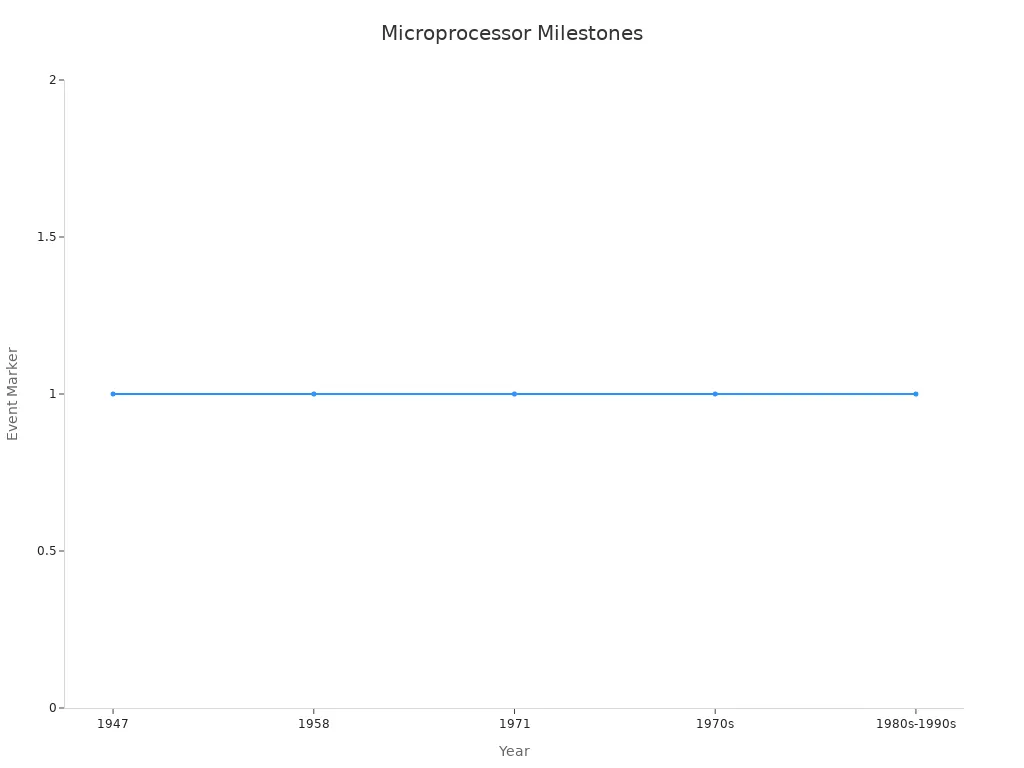
The history of integrated circuits shows their huge impact. From transistors to microprocessors, these inventions changed the world.
Advances in Integrated Circuit Technology
Miniaturization and Nanotechnology
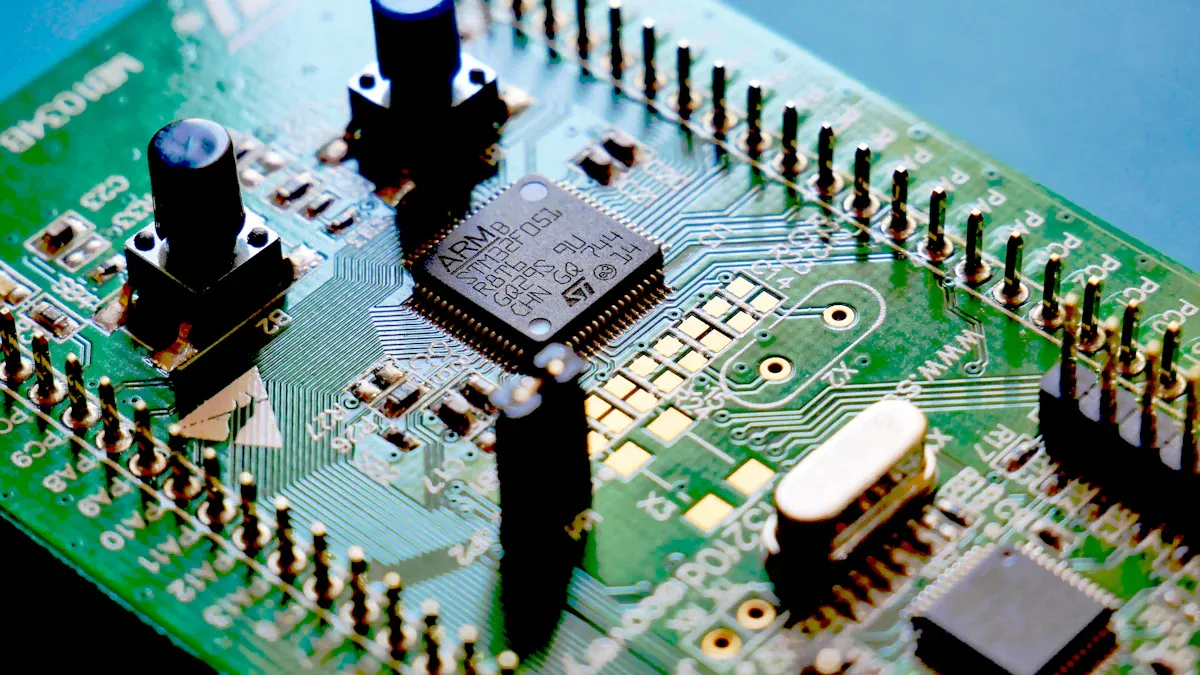
Devices like phones and laptops are smaller and faster now. This is because of miniaturization in integrated circuits. Engineers can fit more parts on one chip. This makes devices work better, use less power, and take up less space. This idea follows Moore’s Law, which says chips double their transistors every 18 months.
Nanotechnology is key to this progress. Scientists work with tiny atoms and molecules. They’ve made big discoveries. For example, transistors are now just 200 nanometers small. Factories can make 22-nanometer structures at 20 wafers per hour. These changes make chips smaller and more powerful.
|
Evidence Type |
Description |
|---|---|
|
System Size Reduction |
Systems shrink 100× in volume every 10 years. |
|
Device Density Increase |
Chips double their devices every 18 months (Moore’s Law). |
|
Transistor Size |
Transistors are now only 200 nanometers in size. |
|
Production Rate |
22-nanometer structures are made at 20 wafers per hour. |
Nanotechnology also helps create tiny antennas, 1,000 times smaller than old ones. These new chips have changed communication systems. They are smaller and save energy. In healthcare, tiny tools study cells without harming them.
Did you know? Smaller chips helped create portable devices and faster communication.
System-on-Chip (SoC) and 3D ICs
System-on-Chip (SoC) puts many parts, like processors and memory, on one chip. This removes the need for extra chips. It makes devices smaller and more efficient. SoC powers things like phones and self-driving cars.
3D ICs stack circuits in layers. This packs more parts into a small space. It also makes chips faster and saves power. For example, Qualcomm’s Snapdragon Ride SoC, launched in January 2024, helps advanced car systems. NVIDIA’s B200 Blackwell chip, released in March 2024, boosts AI with 3D IC design.
Here are some recent breakthroughs in chip technology:
-
June 2024: Intel made an optical chiplet with 64 data channels.
-
May 2024: Nano Lab launched the Cuckoo3.0, a new microchip.
-
November 2024: Samsung introduced the NRD-K chip for AI, 5G, and cars.
These examples show how SoC and 3D ICs are changing the chip industry. They are pushing the digital world forward.
Enhanced Manufacturing Processes
Making chips is now more advanced. Better methods mean higher quality and less waste. Design for Manufacturability (DFM) improves layouts and materials. This makes production faster and reduces mistakes. Real-time systems catch problems early, improving results.
AI and predictive tools have also changed manufacturing. They find issues early and suggest fixes. This cuts waste and improves First Pass Yield (FPY), a key industry measure. New machines and regular maintenance keep everything running well.
-
Predictive tools find problems early, cutting waste.
-
AI studies data to improve production steps.
-
Real-time systems boost machine performance.
-
Training workers reduces mistakes and improves results.
These methods help companies make precise and efficient chips. Because of this, integrated circuits keep advancing industries like healthcare and AI.
Tip: Better manufacturing not only improves chips but also saves energy and helps the environment.
Applications of Integrated Circuits in Modern Industries
Integrated circuits are the core of modern electronics. They help create new ideas in many areas. From running smartphones to powering medical tools, these small chips drive technology forward. Let’s see how integrated circuits are changing gadgets, healthcare, and AI.
Consumer Electronics and IoT
Integrated circuits have made gadgets smarter and faster. For example, your phone uses a chip to process data and connect online. The Internet of Things (IoT) has expanded their use. Chips now power smart devices like fitness trackers and home assistants. These gadgets can talk to each other easily.
With AI and IoT, health tracking has improved. Smartwatches can now do medical scans. They help you check your health and find problems early. They also help manage long-term conditions. AI makes these devices more accurate and easy to use.
Fun Fact: Some IoT devices for breast cancer detection reached 97.5% accuracy in tests. This shows how integrated circuits make healthcare better through gadgets.
Healthcare and Medical Devices
Integrated circuits are key in improving healthcare tools. Devices like medication pumps and monitors use these chips to work well. They ensure care is given safely and on time.
Machine learning, powered by chips, has changed patient monitoring. It reduces false alarms and makes systems more reliable. For example, smart catheters and wireless monitors improve communication between patients and doctors. This makes healthcare more interactive and helpful.
|
Study Focus |
Key Findings |
|---|---|
|
Integrated Medical Devices |
Improved safety by linking data from medical tools. |
|
Machine Learning Applications |
Better care and fewer false alarms in monitoring systems. |
|
Innovative Device Development |
Created smart tools like wireless monitors and advanced catheters. |
These examples show how integrated circuits are making healthcare safer and more focused on patients.
Artificial Intelligence and Machine Learning
AI and machine learning need the power of integrated circuits. Special chips like GPUs and TPUs handle tough AI tasks. These chips are great for things like image recognition and predictions.
GPUs are especially important for AI. They can do many tasks at once, which helps with deep learning. New GPU designs have made them even better. They are now used in gaming, healthcare, and self-driving cars.
Integrated circuits are also vital for AI chipsets. These chipsets run complex programs and power tools like virtual assistants and robots. This shows how integrated circuits help AI grow and improve.
Did You Know? The AI chip market is growing fast because GPUs are so important for high-level AI tasks.
Challenges in Integrated Circuit Technology
Sustainability and Energy Efficiency
Integrated circuits have changed technology but cause environmental problems. Making chips uses a lot of energy, which harms the planet. For example, the ICT sector makes up 2.8% of global carbon emissions. About 75% of this comes from making and assembling microchips. This shows why energy-saving solutions are so important.
Scientists are working on ways to fix these problems. Projects like SRC’s ESH portfolio aim to cut greenhouse gases during chip production. These ideas are still being tested in labs but look promising. Schools and companies are also teaming up to find better ways to save resources and protect the environment.
|
Evidence Type |
Description |
|---|---|
|
Energy Usage |
Making chips uses too much energy. |
|
Resource Depletion |
Chip production risks running out of key materials. |
|
Environmental Impact |
Carbon emissions and waste harm the planet. |
|
Collaborative Efforts |
Teams work together to make chip production greener. |
Manufacturing Complexities
Making microchips is hard and needs great accuracy. Different products and defects make it tricky to check performance. Old methods, like yield analysis, don’t handle these issues well. Engineers now use new tools that measure defect size and spread for better results.
Data tools help solve these problems. Automated systems study production data to find errors and improve quality. These tools help fix supply chain issues and make production smoother. Using technology, factories can handle the tough parts of making chips better.
Security Concerns
Microchips run important systems, so security is a big worry. Hackers can attack weak spots in chips to steal data. For instance, side-channel attacks take advantage of flaws in chip designs. This is dangerous for industries like healthcare and banking.
To stop these attacks, engineers are creating safer chip designs. They use methods like hardware encryption and tamper-proof features to block hackers. Regular updates and tests also keep chips safe from new threats. By focusing on security, we can trust the technology we use every day.
Future Trends in Integrated Circuit Technology
Quantum Computing and Neuromorphic Chips
Quantum computing and neuromorphic chips are the future of technology. Quantum computing uses special physics to solve hard problems. It has huge power and can change fields like security and medicine. But, it still faces big challenges like cooling systems and heat control.
Neuromorphic chips work like the human brain. They handle tasks like recognizing images and understanding speech. These chips use less energy, making them great for phones and self-driving cars. They can learn and get better over time. This is important for robots and smart assistants.
|
Region |
Growth Reasons |
|---|---|
|
Asia Pacific |
Fast growth due to better semiconductors and smaller ICs. |
|
Europe |
Growth from projects like the EU’s NimbleAI for neuromorphic chips. |
|
Quantum |
Big changes expected in security, AI, and new materials. |
|
Neuromorphic |
Early uses include object detection, smart assistants, and low-energy devices. |
Innovations in Materials and Design
New materials and designs are changing how chips are made. Scientists are testing materials like graphene and silicon carbide. These materials handle heat better and make circuits faster. 3D printing also helps create smaller and more complex chips.
The chip market is growing fast, with a 13% yearly increase from 2024 to 2031. This is because of more IoT devices, AI tools, and 5G networks. These trends show the need for smarter designs to handle modern tech demands.
Tip: Watch for graphene chips. They might change technology soon.
Integrated Circuits in Space Exploration
Space missions depend on strong and reliable integrated circuits. Chips in spacecraft must survive extreme heat and radiation. Engineers make these chips tough to ensure they work in space. For example, advanced chips help with navigation and communication during missions.
As space missions grow, the need for special chips increases. These chips power Mars rovers and satellite systems. They help us explore space and also bring new ideas to industries on Earth.
Integrated circuits changed technology with important steps:
-
Transistors, made in 1947, helped create smaller gadgets.
-
Microprocessors in the 1970s made computers much better.
-
Moore’s Law led to smaller and faster chips.
-
SoCs made devices work smarter and use less power.
Solving energy and safety issues will help them grow more.
FAQ
What is an integrated circuit?
An integrated circuit is a tiny chip with many electronic parts. It helps devices work by processing data and controlling systems quickly.
How does Moore’s Law affect integrated circuits?
Moore’s Law says chips double their transistors every 18 months. This makes devices smaller, faster, and much more powerful.
Why are integrated circuits important for AI?
Integrated circuits help AI by processing data very quickly. Chips like GPUs and TPUs handle hard tasks like recognizing images and making predictions.
Tip: Learn how GPUs make gaming and AI better at the same time!