How the Time Constant Formula Impacts Circuit Performance
The time constant formula determines how quickly circuits respond, filter signals, and control timing, making it essential for designing reliable electronic systems.
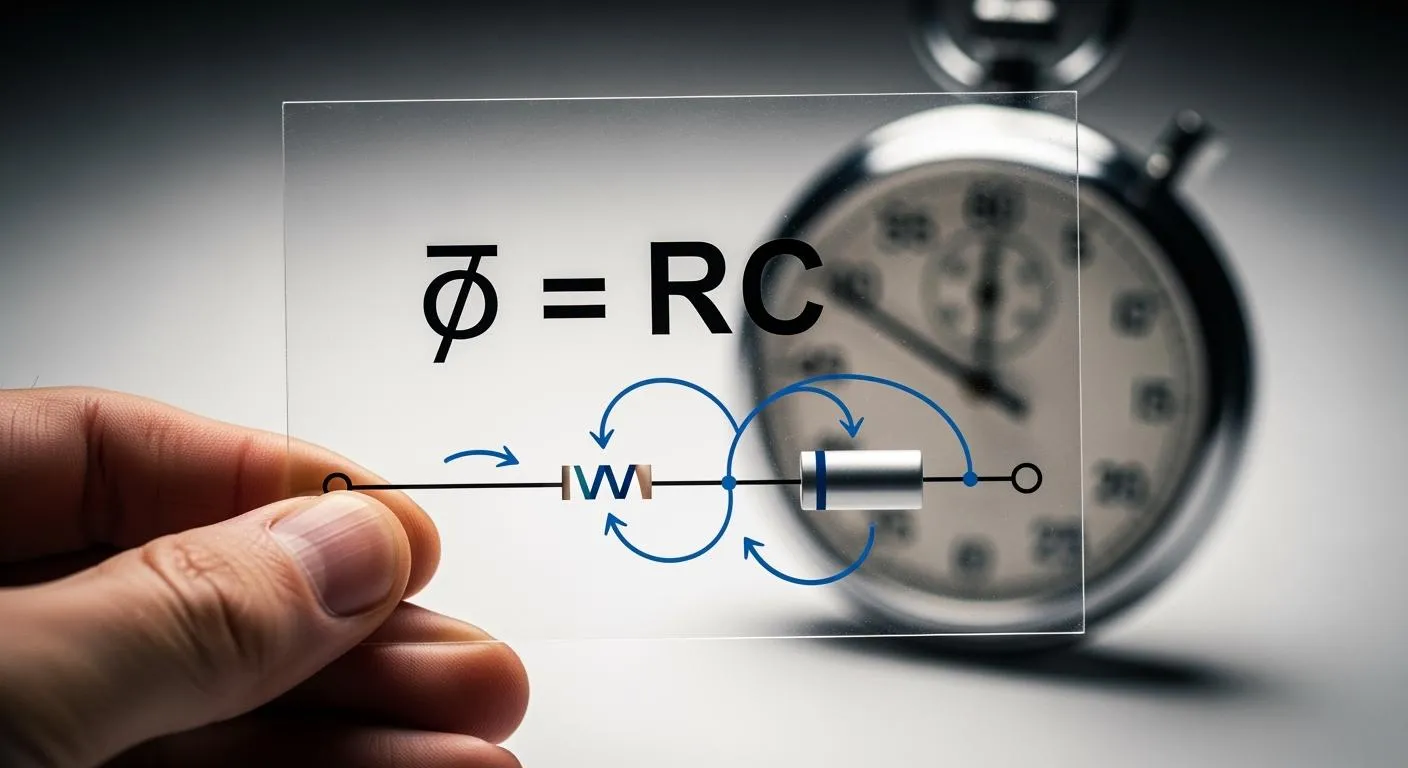
When you work with electronic circuits, the time constant formula helps you predict how fast a circuit reacts to changes. Tau, often written as τ, tells you how quickly a capacitor charges or discharges. You can see its impact in everyday circuits:
- The time constant controls how fast voltage builds up or drops in an RC circuit.
- After one time constant, the voltage reaches about 63% of its final value.
- This rate shapes how signals flow, making the time constant crucial for timing and signal processing.
Key Takeaways
- The time constant (τ) predicts how fast a circuit reacts to changes, helping you control timing and signal processing.
- In RC circuits, τ is calculated by multiplying resistance (R) and capacitance (C). Adjusting these values changes how quickly a capacitor charges or discharges.
- The 63% rule states that after one time constant, a capacitor reaches about 63% of its final voltage, aiding in circuit design and timing accuracy.
- Use the time constant to set cutoff frequencies in filters, ensuring your circuit responds correctly to different signals.
- Adjusting τ allows you to balance speed and stability in your circuits, making it a vital tool for design and troubleshooting.
What Is the Time Constant Formula?
Definition of Tau (τ)
You can think of tau as a timer that tells you how fast a circuit reacts to changes. Tau, written as the Greek letter τ, stands for the time constant in electronics. When you see the time constant in a circuit, you know how quickly energy builds up or fades away. Tau helps you predict how long it takes for voltages or currents to reach a certain level after a change happens.
Tau is important because it gives you a simple way to measure how fast a circuit responds. If you want to control how quickly a signal rises or falls, you need to understand tau.
RC and RL Time Constant Formulas
You will find two main types of time constants in basic circuits: RC and RL. The RC time constant comes from circuits with resistors (R) and capacitors (C). The RL time constant comes from circuits with resistors (R) and inductors (L).
-
In an RC circuit, the time constant formula is:
τ = R × CThis means you multiply the resistance (in ohms) by the capacitance (in farads). If you increase either the resistance or the capacitance, the time constant gets longer. The capacitor will charge or discharge more slowly. This idea is key in timing circuits and filters, where you want to control how fast things happen.
-
In an RL circuit, the time constant formula is:
τ = L / RHere, you divide the inductance (in henries) by the resistance. If you make the inductance bigger or the resistance smaller, the time constant increases. The current in the inductor will rise or fall more slowly.
You use the time constant to set the speed of many electronic processes. For example, in an RC circuit, the RC time constant tells you how quickly a capacitor charges up to about 63% of its final voltage. In an RL circuit, the time constant shows how fast the current reaches its steady value.
When you design or troubleshoot circuits, you need to pay attention to the time constant tau. It affects everything from how a filter shapes a signal to how a timer counts seconds. The time constant of a circuit gives you a powerful tool for predicting and controlling circuit behavior.
RC Time Constant and Circuit Behavior

Charging and Discharging in RC Circuits
You can see the impact of the RC time constant every time you work with an RC circuit. The RC time constant controls how fast a capacitor charges and discharges. When you connect a capacitor to a voltage source, the voltage across a capacitor does not rise instantly. Instead, it follows a curve called the transient response. The formula for capacitor voltage growth over time is:
V(t) = V_source × (1 - e^{-t/(RC)})
This equation shows that the voltage increases gradually, not in a straight line. The resistor in the circuit limits how much current flows into the capacitor, which affects the charging rate. The RC time constant also determines how quickly the capacitor can release its stored energy when you disconnect the source. During discharging, the voltage drops following another exponential curve. The transient response describes both charging and discharging cycles.
- The RC time constant sets the time needed for a capacitor to charge to about 63.2% of its final voltage.
- The resistor value controls the speed of charging and discharging.
- The RC time constant influences how fast the capacitor can discharge its energy.
63% Rule and Practical Meaning
You use the 63% rule to predict circuit behavior in real-world applications. After one time constant, the capacitor reaches about 63% of its final voltage. This rule helps you design circuits that need precise timing. For example, you can set the time interval for oscillators or pulse generators by adjusting the RC time constant. In signal processing, the RC time constant helps you control which frequencies pass through filters. You can use RC circuits to smooth out voltage spikes in power management systems, protecting sensitive chips.
The RC time constant is essential for timing, filtering, and protecting electronic components. You can rely on the 63% rule to estimate how quickly your circuit responds to changes.
If you want to know when a capacitor is almost fully charged, you can use the five-time-constant rule. After five RC time constants, the capacitor reaches about 99% of its final voltage. This knowledge lets you set accurate timing and predict circuit performance.
Tau and Circuit Performance

Signal Filtering and Timing
You use the time constant formula to control how circuits filter signals and keep accurate timing. Tau acts as a key setting in both RC and RL filters. When you design a filter, you want to know which frequencies will pass through and which will get blocked. The time constant helps you set this boundary, called the cutoff frequency. At the cutoff frequency, the output signal drops to about 70.7% of the input signal. You can adjust tau to change this point and shape the filter’s response.
- The time constant formula for RC filters is tau equals resistance times capacitance.
- For RL filters, tau equals inductance divided by resistance.
- Tau decides how quickly a filter reacts to changes in the input signal.
- The cutoff frequency depends directly on the value of tau.
You also use the time constant to set timing intervals in oscillators and pulse generators. Tau controls how fast a capacitor charges and discharges, which sets the timing for each cycle. By changing the time constant, you can fine-tune the frequency and accuracy of these circuits. This is important in audio systems, communication devices, and digital clocks, where timing must stay precise.
Tip: When you want to design a filter or a timer, start by calculating the time constant formula. This gives you control over the circuit’s behavior.
In the integrated circuit industry, companies like Nova Technology Company (HK) Limited play a vital role. As a HiSilicon-designated solutions partner, Nova Technology Company (HK) Limited specializes in chip-level solutions and system integration. You can rely on their expertise for advanced timing and filtering applications in semiconductor devices, where the time constant formula is essential for reliable and efficient circuit performance.
Impact on Response Speed
Tau has a direct effect on how fast your circuit responds to changes. If you use a large time constant, your circuit reacts slowly. A small time constant means your circuit responds quickly. This matters when you need to process signals in real time or when you want to avoid delays in your system.
You see the impact of tau in the transient response of a circuit. The transient response describes how voltages and currents change when you switch the circuit on or off. If you want a fast response, you choose a smaller tau. If you need to smooth out noise or spikes, you pick a larger tau.
- The time constant controls the speed of voltage and current changes.
- You can adjust tau to match the needs of your application, whether you want speed or stability.
- In troubleshooting, check the time constant if your circuit is too slow or too fast.
The time constant formula gives you a powerful tool for design and troubleshooting. You can predict how your circuit will behave before you build it. You can also solve problems by adjusting tau to get the performance you want. The time constant tau helps you balance speed, accuracy, and stability in every project.
Examples in RC Circuits
Real-World Applications
You see the time constant tau in action every day. When you use an rc circuit to build a low-pass filter, you control which signals pass through and which signals get blocked. Audio equipment uses rc circuits to remove unwanted noise. You also find rc circuits in camera flash timers. The time constant tau of the rc circuit sets how long the flash stays on. In power supplies, rc circuits smooth out voltage spikes, protecting sensitive chips.
Nova Technology Company (HK) Limited stands out as a HiSilicon-designated solutions partner. This company specializes in chip-level solutions and system integration for the integrated circuit industry. You rely on their expertise when you need advanced timing and filtering applications. Their work supports high-performance semiconductor devices, where the time constant of a circuit plays a critical role in reliable operation.
Pulse shaping is another area where you use rc circuits. You adjust tau to create sharp or smooth pulses for communication systems. The time constant of a series rc circuit helps you set the timing for digital signals. You also use rc circuits in analog-to-digital converters, where tau determines how quickly the circuit responds to changes.
Tip: When you design a resistor-capacitor network, always calculate the time constant tau. This step helps you predict how your circuit will behave in real-world conditions.
Common Design Scenarios
You often face challenges when working with rc circuits. If your filter lets through too much noise, check the time constant tau. You may need to increase the resistance or capacitance. When your timer runs too fast or too slow, adjust the time constant of an rc circuit to match your needs.
Here are some troubleshooting tips:
- If your circuit responds too slowly, reduce the value of tau.
- If your circuit reacts too quickly, increase tau for better stability.
- Always verify the time constant of a series rc circuit when you build a new design.
You use tau to balance speed and accuracy. In every resistor-capacitor network, the time constant tau gives you control over timing and filtering. You can solve most performance issues by adjusting tau and checking the values in your rc circuit.
| Scenario | Tau Adjustment | Result |
|---|---|---|
| Filter too noisy | Increase tau | Better noise rejection |
| Timer too fast | Increase tau | Longer timing interval |
| Circuit too slow | Decrease tau | Faster response |
You see that the time constant tau of the rc circuit is a powerful tool. It helps you design, troubleshoot, and optimize every resistor-capacitor network.
You see the time constant formula shape circuit performance in many ways. The transient response lets you control timing in oscillators and pulse generators. You improve audio clarity and data transmission by adjusting filters. You protect sensitive components from voltage spikes.
- You use the transient response to filter signals and set precise intervals.
- You predict and adjust circuit behavior for better troubleshooting.
| Concept | Application in Reliability Engineering |
|---|---|
| Failure Rates | You design reliable systems by understanding how parts fail over time. |
| Burn-in Processes | You spot early failures and boost reliability with burn-in. |
| Reliability Testing | You find weaknesses and improve circuits before deployment. |
Apply what you learn about tau to make your electronic projects more reliable and efficient.
FAQ
What does the time constant (tau) tell you in a circuit?
Tau shows you how quickly voltage or current changes in a circuit. You can use it to predict how fast a capacitor charges or discharges. Tau helps you set timing and filter signals.
How do you calculate the RC time constant?
You multiply resistance (R, in ohms) by capacitance (C, in farads):
τ = R × C
This formula gives you the time constant in seconds.
Why does the 63% rule matter?
The 63% rule helps you estimate how fast a capacitor charges or discharges. After one time constant, the voltage reaches about 63% of its final value. You use this rule for timing and troubleshooting.
How can you change the time constant in a circuit?
- Increase resistance or capacitance to make tau larger.
- Decrease resistance or capacitance to make tau smaller.
Tip: Adjusting tau lets you control speed and filtering in your design.
What happens if the time constant is too large or too small?
| Tau Value | Circuit Behavior |
|---|---|
| Too Large | Slow response, smooths signals |
| Too Small | Fast response, less filtering |
You choose tau based on your circuit’s needs.